Uring Manggagawa, Hukbong Mapagpalaya!

Sosyalismo ang Lunas! Ibagsak ang mapang-api't masibang kapitalistang sistema! Manggagawa sa Lahat ng Bansa, Magkaisa!

Martes, Nobyembre 20, 2012

ps - No Railroading of New Taxes!


PRESS STATEMENT
November 19, 2012
Leody de Guzman
National President
Bukluran ng Manggagawang Pilipino (BMP)

No Railroading of New Taxes!
Review the Present Anti-Poor Tax System!
Reform towards a Progressive System of Taxation!

In the light of recent controversies involving taxes on gold and "sin" products, workers are calling on Congress and the Senate not to railroad the passage of new taxes.

Both Houses should prove institutional independence not only from Malacanang but also from the International Monetary Fund (IMF) especially with Christine Lagarde issuing a statement supporting new taxes including a levy on cellphone text messages.

Instead, we demand a status quo on taxes pending the review for an omnibus amendment of the entire taxation system. The current system relies more on sales taxes borne by consumers (through the EVAT) and on compulsory deduction of withholding taxes to wage-earners. It is not just anti-poor and regressive but also unconstitutional.

Article 6 Section 28 of the 1987 Constitution is clear: "The rule of taxation shall be uniform and equitable. The Congress shall evolve a progressive system of taxation".

But tax reform is not just a legal question but a matter of life and death for Filipino workers and their families.

Workers' take home pay is a mere pittance. Not only because wages are below the necessary costs for a decent life. Worse, it is further reduced by withholding taxes and contributions to social welfare. Not only are starvation wages subject to withholding taxes. More so, it is subject to the EVAT when we purchase our families' needs.

Those who have less in life bear more of the tax burden. Unlike the privileged elite who have their lawyers and accountants to disguise their crimes of tax evasion into innocent (and legal!) acts of "tax avoidance".

Hence, an overhaul of the current system towards progressive taxation, based on income and property, is a legal, moral, democratic and nationalist imperative. Tax the rich, not the poor! Resist the impositions of IMF and other foreign finance institutions!

Biyernes, Nobyembre 9, 2012

ps - Junk Sin Tax Bill - rally at DoF


PRESS STATEMENT
09 November 2012


Militant Labor Hold Rally at the Department of Finance to Demand the Junking of the Sin Tax and Raise Corporate Tax Instead 

Irate workers and ambulant vendors belonging to Peoples Coalition Against Regressive Taxation (PCART) trooped to the Department of Finance (DOF) today to condemn the department for prodding the Senate Ways and Means Committee chairman Senator Franklin Drilon to execute the government's plan to raise forty to forty-five billion pesos by legislating a new sin tax law.

The militant workers labeled the DOF as a butcher of their jobs and livelihoods. They likewise  urged the department to tax the rich and not the poor, a central principle in taxation. The DOF is the government's primary agency that designed and convinced legislators to enact a new sin tax law to fulfill the government's fiscal requirements.

According to Gie Relova, Secretary-General of Bukluran ng Manggagawang Pilipino-National Capital Region and Rizal chapter (BMP-NCRR),  "Secretary Cesar Purisima has only displayed its insensitivity to the Filipino workers and farmers by pushing for a regressive tax measure that will displace more than three million already productive Filipinos while the tycoons continue reap billions of pesos in profit". 

"The tycoons and traders should be the only targets of the government's taxation schemes and not the general public because logic dictates that they are the ones with the capacity to pay unlike the workers and farmers or the end-consumers. The government must instead pursue raising corporate taxes", the labor leader added. 

While JC Gatungay, Chairperson of Samahan ng mga Manininda sa Komunidad, an organization of sari-sari store owners claim that they are unconvinced with the pending sin tax bill because of the government's schizophrenic programs. On one hand, it spends billions of pesos in promoting micro, small and medium enterprises at the same time pursuing an unjust sin tax measures that will inevitably destroy already established livelihoods and local industries.

The coalition reiterated its call to totally scrap the sin tax bills because of its regressive nature and will be a financial burden shouldered by end-consumers and not by the tobacco and alcohol tycoons.  

ps - anti-Sin Tax Bill - tagalog statement


PRESS STATEMENT
09 November 2012

Militanteng Manggagawa Rinalihan ang Department of Finance 
para Ipanawagan ang Pagbabasura sa  Sin Tax at  
Pagtataas na Lamang ng Corporate Tax

Kinalampag ng mga galit na mga manggagawa kasama ang mga takatak vendor at mga may-ari ng sari-sari store sa ilalim ng Peoples Coalition Against Regressive Taxation (PCART) ang Department of Finance (DoF).  Kinundena nila ang DoF dahil sa kanyang patuloy na pag-e-engganyo sa Chairman ng Senate Ways and Means Committee na si Senador Franklin Drilon na ipatupad ang plano ng gobyerno na magpasulpot ng apatnapu hanggang apatnapu't-limang bilyong piso kada taon sa pamamagitan ng pagsasabatas ng panukalang Sin Tax sa mga produktong tabako at alkohol.

Binansagan ng mga militante ang DOF na bedugong ahensya na papatay sa kanilang mga hanapbuhay at kabuhayan. Iginiit din nila sa departamento na patawan na lamang ng buwis ang mga mayayaman at hindi ang maralita, isang sentral na prinsipyo sa pagbubuwis. Ang DOF ay ang pangunahing ahensya ng gobyerno na nagdisenyo at nangumbinsi sa mga mambabatas na isabatas ang isang bagong buwis sa para punuan ang kakulangan sa badyet ng gobyerno. 

Ayon kay Gie Relova, Secretary-General ng Bukluran ng Manggagawang Pilipino-National Capital Region and Rizal chapter (BMP-NCRR),  "Ipinamamalas lamang ni Secretary Cesar Purisima ang kanyang kawalan ng puso sa mga manggagawa at magsasakang Pilipino dahil patuloy nitong itinutulak ang atrasado sistema ng pagbubuwis na dudurog sa hanapbuhay at kabuhayan ng mahigit tatlong milyong produktibong Pilipino habang patuloy na tumatabo ng bilyon-bilyong pisong tubo ang mga kapitalista". 

"Mga kapitalista't mangangalakal lamang ang dapat patawan ng buwis ng gobyerno at hindi ang buong publiko dahil lohikal lamang na sila ang may kapasidad na magbayad ng buwis hindi tulad ng mga manggagawa't magsasaka o mga ordinaryong mamimili. Ang kailangang gawin ng gobyerno ay magtaas na lamang ng corporate tax", dagdag ng lider-manggagawa. 


Habang para kay JC Gatungay, Chairperson ng Samahan ng mga Manininda sa Komunidad, isang organisasyon ng mga may-ari ng sari-sari store hindi sila kumbinsido sa panukalang Sin Tax dahil sa magka-kontrang programa ng gobyerno. Sa isang banda, gumagastos ng bilyong-bilyon piso ang gobyerno para isulong ang micro, small at medium enterprises o mga maliliit na negosyo habang kasabay ding isinusulong ang hindi makatarungang Sin Tax na siyang papatay sa mga estabilisado nang mga kabuhayan at lokal na industriya. 

Patuloy na giniit ng koalisyon ang kanilang panawagan na kailangan nang ibasura ang mga panukalang Sin Tax dahil sa atrasadong kalikasan nito at magiging pabigat lamang sa mga ordinaryong mamimili at hindi sa mga kapitalista ng tabako at alkohol.  

Sabado, Oktubre 6, 2012

WORKERS’ APPEAL to Netizens (and to Anonymous Philippines)

WORKERS’ APPEAL to Netizens (and to Anonymous Philippines)

We join you in your continued vigilance for our civil and political rights and in your struggle against the Cybercrime Prevention Act of 2012.

Impressed are we by your youthful vigor, boldness and creativity, that we seek your help in increasing online awareness on the following problems that beset the workers and the poor: (a) low wages, (b) contractualization, (c) high power rates and, (d) spiraling fuel prices.

These problems are caused by policies promoted by the very same lawmakers and public officials who are now assaulting the people’s right to free expression in the Internet. They are (a) the tacit cheap labor policy, (b) Court decisions which allow outsourcing and subcontracting and the loopholes in the Labor Code that promote contractual over regular employment, (c) the privatization of the power industry due to the EPIRA law, and (d) the deregulation of the oil industry.

To the Anonymous Philippines, inasmuch as we are impressed by your brazen display of technical skill and devotion to the cause, insomuch do we implore on you to seek legitimate avenues of dissent by using the Constitutional right to free expression to highlight “gut issues”, which affect the majority of the Filipino people. Real change will come by infusing the dynamism of cyber-protests to the practical movement of the working masses. Unite against a common enemy. Together, we will win! #

Huwebes, Oktubre 4, 2012

Philec workers staged their strike


Press Release
October 4, 2012

PHILEC WORKERS STAGED THEIR STRIKE THIS MORNING


Workers from Philippine Electric Company (Philec) staged their strike this morning after negotiations for a new collective bargaining agreement has been deadlocked. The striking workers belong to Philec Employees and Workers Association (PEWA), and a member of the working class organization Bukluran ng Manggagawang Pilipino - National Capital Region-Rizal (BMP-NCRR).

Philec has its address at Kaytikling Rd., Bo. Dolores, Taytay, Rizal. It is a subsidiary of First Philippine Electric Corp., a member of the Lopez Group, and is engaged in the manufacture of distribution transformers.

According to Rogelio Mira, PEWA 2nd Vice President, "We launched our strike after a deadlock in our collective bargaining agreement (CBA) to express our unity and to defend our right as workers. We are disgusted by the management’s strategy of closure after the failure in our CBA negotiations. Our proposal for a new CBA was countered by closure.”

Meanwhile, Gie Relova, secretary general of the BMP-NCRR, calls for workers from different workers organizations to support the said strike. “The workers union at Philec is already one of the few labor unions left in our country. The capitalist class continues to destroy these unions as their solution to the crisis of capital. This should not be. The workers should unite against these schemes of capital against the working class.”

For more information, pls contact Rogelio Mira at 0908-8967737, and Gie Relova, BMP-NCRR secretary general, at 0915-2792749


Huwebes, Setyembre 6, 2012

Ang ating paninindigan laban sa patakaran ni Pnoy sa mga maralitang lungsod


Ang ating paninindigan laban sa patakaran ni Pnoy sa mga maralitang lungsod 

Pambungad: Nilalayon ng papel na makabuo ng posisyon laban sa pahayag ng gobyerno kaugnay ng deklarasyon nito na pag-demolis sa lahat ng mga kabahayan na nakatirik sa mga danger zones makaraan ang pananalasa ng bagyo at habagat. Nais ring buksan ng dokumento ang diskusyon sa anti-kapitalistang linya at pagsusuri sa puno’t dulo ng usapin ng maralitang lungsod. Ang isyu ng demolisyon, mapaminsalang kalamidad natural man o gawa ng tao, hanapbuhay, serbisyong panglipunan at ang mga polisiya ng gobyerno ay dapat makita sa balangkas ng mapagsamantalang kapitalistang sistema na kinakatawan ni Noynoy Aquino bilang Chairman of the Board at ng uring manggagawa na bumubuo sa hanay ng maralitang mamamayan. 

Sa proseso ng mga diskusyon ay inaasahang mapagyayaman pa ang nilalaman ng papel at makabuo ng higit pang talas sa pagdadala natin sa isyu ng maralita hindi bilang sektor kungdi bilang namumuong pwersa ng kilusang manggagawa sa yugto ng pagsusulong ng demokratikong pakikibakang hahawan sa landas patungong sosyalismo. 

Sa pananalasa ng mga kalamidad gaya ng mga nagdaan at paparating pang mga bagyo nakatagpo ang gobyerno ng kumbenyenteng palusot upang walisin lahat ang mga itinuturong dahilan ng pagbabara ng mga lagusan ng tubig na nagdulot ng mga matitinding pagbaha. At dahil dito, buong-yabang na idineklara ni Pnoy ang pwersahang pag-demolis sa mahigit sa 195,000 informal settlers o mga iskwater sa Metro Manila na tatangging aalis sa mga danger zone gaya ng tulay, estero, tabing-ilog at tabing-dagat na daluyan ng tubig. Ipapatupad din ang three (3) meter easement sa mga tabing ilog at creek na madadag-dag pa sa bilang ng mga mawawalan ng tirahan. 

Ang problema sa patuloy na pananalasa ng baha ay simplistikong tinitingnan ng gobyerno na dulot ng mga pasaway na mga maralitang naglulungga sa mga daluyan ng tubig. Tayo ang nakababara kaya dapat na tayo ang tanggalin. Ang nakikita ng gobyerno ay mga madudungis at mga baboy na mga iskwater na kung saan-saan nagtatapon ng kanilang mga basura habang pikit-mata ito sa mga naglalakihang gusaling nakahambalang mismo sa mga daanan ng tubig. Mga salaulang pabrika na nagtatapon ng mga mapaminsalang basura, walang-habas na pagmimina, pagka-kalbo ng kagubatan at iba pang mga kababuyan ng mga kapitalista sa paghahangad ng malaking tubo na lalo pang nagpapabilis sa pag-init ng daigdig o global warming. 

 Ang problema sa gobyerno, tayo lang ang kayang-kayang pagbuntunan ng lahat ng sisi sa mga pagbaha at hindi makita ang mga baradong programang pang-ekonomiya na hindi lumulutas sa patuloy na paglobo ng mga mahihirap na mamamayan na napipilitang manirahan sa kahit sa pinaka-mapanganib na lugar. Kung susuriin marami sa mga naninirahan sa mga danger zones ay mga maralitang galing na sa kung saan-saang relocation sites sa bansa. Marami ang nagsibalikang relocatees dahil sa kawalan ng hanap buhay sa mga pinagdalhan sa kanilang relocation areas. May mga napaalis din bunga ng bantang demolisyon at cancellation of rights dahil sa kawalan ng pera para sa mga bayarin sa mga relocation areas. 

Ang dapat makita at dapat aminin ng gobyerno ay ang palpak na ipinatutupad na polisiyang pang-ekonomiyang neo-liberal na patuloy na nakaasa sa dayuhang pamumuhunan habang binabale-wala ang kapakanan ng kanyang mamamayan. Ang dapat makita ng gobyerno ay ang nakatakdang paglobo pa ng bilang ng mga maralitang lungsod na titira sa kahit sa pinakamapanganib na lugar dahil sa kakulangan at kawalan ng hanapbuhay dahil ang programang pang-ekonomiya ay inilaan hindi sa mahihirap na mamamayan kungdi sa mga dayuhan at bilyonaryong iilan. 

Negosyo hindi serbisyo

Ang programang pabahay ay para pagkakitaan ng mayayaman hindi para sa serbisyong panglipunan. Walang libreng pabahay, walang libreng relokasyon. At dahil negosyo ang trato ang sinumang negosyante ay hindi aaktong pilantropo na ilalaan ang kanyang kapital sa negosyong walang hahamiging limpak-limpak na tubo. Ang dahilan kung ganun ng mga kabiguan ng programang pabahay ng kasalukuyan at ng mga nagdaang administrasyon ay ang patuloy na paghahangad ng mabilis na ganansyang iluluwal (tubo) buhat sa programa. Ang mga lupain na marapat na maging ligtas na lugar para sa tirahan ng mamamayan ay nakalaan lamang sa mga panginoong may kapital, ang tunay na Boss ni Aquino. 

Ilan sa mga halimbawa ng pagkasugapa ng gobyerno (ng kapitalista) sa tubo ay ang proyektong Quezon City Business District na sumasakop sa Old Capitol Site, Philcoa, Vasra (SRA), North Triangle, Veterans, NIA, Botanical, Forestry at kung saan-saang bahagi ng Lungsod na naging tahanan at matagal na pinagyaman ng mga mamamayan sa mahabang panahon. Itataboy ang mga residente kapalit ng pagtatayo ng mga shopping malls, matatayog na condominum, activity centers at iba pang mga gusaling magsisilbing show case ng isang ”maunlad na bansa” upang umakit pa ng mga dayuhang mamumuhunan. 

Itataboy tayo ng gobyerno dahil sa tingin nitong higit na ganansya sa negosyo ngunit sa mga pagtatapunang relokasyon ay hindi tayo ligtas sa matataas na bayaring obligado nating bayaran dahil pa rin sa cost recovery, cross subsidy at scalating scheme ng amortization ng negosyo pa rin na proyektong pabahay ng rehimeng Aquino. 

Ang karanasan sa Isla Puting Bato at Navotas

Hindi natin mababago sa kasalukuyan ang ngit-ngit ng kalikasan ganundin ang mga sakunang dulot ng mga aksidente at asahan pang maraming buhay pa ang kikitlin sa mga araw pang darating na pipinsala sa pinaka-bulnerableng seksyon ng lipunan. Ang masaklap, tayo na ang nasalanta tayo pa ang patuloy na pini-peste ng kawalang-puso ng gobyerno. Hindi kalabisang sabihing ipinagbubunyi pa yata ng gobyerno ang kapighatian ng maralitang nabiktima ng samut-saring kalamidad at sunog dahil nalibre ito sa pag-demolis sa mga tirahan.

Patunay dito ang karanasan ng mga maralita sa Isla Puting Bato sa Tundo na hindi na nakabalik sa lugar na kinatirikan dati ng kanilang kabahayan dahil itinaboy na sila ng PPA dahil sa modernisasyon at pagsasa-pribado sa nabanggit na lugar sa North Harbor. Ganito din ang istorya ng mga kasama natin sa mga nasalantang mga kapatid natin sa Navotas na matapos masunugan at bayuhin ng samut-saring bagyo at hanging habagat ay nananahan na lamang ngayon sa mga evacuation centers sa iba’t-ibang Barangay covered courts sa Lungsod at hindi na makabalik sa dati nilang tirahan. 

Ang mga karanasang nabanggit sa Navotas at Maynila ay ilan lang sa patunay na sa ”kamalasang” sinasapit ng mga residente ay klarong ”biyaya” sa mga kapitalistang titiba ng limpak-limpak na tubo sa mga binuksang oportunidad sa negosyo ng samut-saring mga kalamidad, gawa man ito ng tao o gawa ng kalikasan. Ang pagpapa-una sa interes ng negosyo bago ang serbisyo’t kalinga sa nagdarahop na mamamayan ay tatak ng isang gobyernong elitistang ang tingin sa mga maralita ay mga basurang dapat walisin. Anuman ang sapiting kalamidad, parang buwitreng nagmamatyag ang mga kapitalistang anumang oras na makakita ng oportunidad ay sasalakay at lalapa sa mga nakahandusay na biktima. Para sa gobyerno at kapitalista, anumang panahon lahat ay pagkakataon upang tumiba ng tubo. Business as usual. 

Hindi tayo magtataka kung may nananalangin na sana’y bumagyo pa nang sa ganun ay ma-itaboy ang mga nakahambalang at istorbo sa negosyong mga iskwater sa kahabaan ng R-10 sa Maynila hanggang sa mga kalsada at baybayin ng Navotas. 

Ang ating hamon sa gobyernong Aquino

May pondo daw na sampung bilyon ang administrasyon para sa relokasyon ng 195,000 na maralita na nasa danger zones. Pondo ito para sa relokasyon o yung proseso ng pagdi-demolis at paghakot mula sa mga demolition areas papuntang relocation sites. Ito ang ipinagyayabang ni Pnoy na solusyon sa problema ng mga maralita sa danger zones na syempre pa’y malabo pa sa tubig-baha na lulutas sa problemang binabanggit.

Subukan nilang gibain ang tirahan ng libo-libong maralitang lungsod na ayon sa gobyerno ay sanhi ng pagbaha at paglubog partikular sa Kalakhang Maynila. Saan tayo dadalhin ng hambog na administrasyong ito? Sa Kasiglahan Village na kumitil ng buhay ng mga residenteng inilipat duon ng pamahalaan makaraang sunugin at gibain ang kanilang kabahayan sa Lungsod ng Quezon? Ganito ba ang pinagmamalaki ng gobyernong relokasyon na nakatuntong pala sa mismong lagusan ng tubig ng San Mateo at ang mga ginawang pabahay ay yari sa mga mababang uri na materyales? Ang lakas ng loob ng gobyernong paratangan tayong mga matitigas ang ulong ayaw magsilikas o magsilayas sa ating mga barung-barong sa mga tinatawag nilang danger zones yun pala’y para lamang isadlak sa mga death zones. 

Nasa gobyerno ang lahat ng puwersa upang mapalayas tayo sa ating mga lungga. Ngunit wala ito sa katinuan na makita ang paulit-ulit nating sinasabi na kailanman ay hindi malulutas ang problema ng paninirahan ng mamamayan kung hindi nito matutugunan ang problema sa ating kabuhayan. Maari nilang dahasin ang mga maralita at sapilitang hakutin sa mga relocation sites ngunit hindi nila mapipigilan ang muling pagbalik ng mga tao dahil nga sa kawalan ng ikabubuhay at miserableng kalagayan sa mga nabanggit na lugar ng relokasyon. 

Ang problema sa gobyerno ay ang tingin nitong tayo ay mga basurang mga walang silbi. Ang hindi nito makita ay ang kolektibo at produktibong lakas ng mga mamamayang binubuo ng mga manggagawa bilang pangunahing puwersa para sa tunay na kaunlaran. Ang patakarang pribatisasyon, deregulasyon at iba pang mga patakaran sa ilalim ng neo liberal na polisiya ng pamahalaan ang salot na magluluwal pa ng henerasyon ng mga mamamayang mananahan kahit sa kasingit-singitan o pinakamapanganib na mga lugar sa lungsod.

Gayung ipinagyayabang nito ang diumano’y ranggo ng Pilipinas bilang pangalawa sa may pinakamataas na economic growth sa rehiyon ano’t hindi makita ng mga matatalinong taga-plano ng administrasyong Aquino na ang problema sa paninirahan ay problema sa kabuhayan. Walang titira sa lungga ng daga kung sasapat ang kanyang kinikita para bigyan ng matinong masisilungan ang kanyang pamilya. 

Ang mga kahilingang ating ipinaglalaban 

1. Paglalaan ng pondo para sa pagtatayo ng mga proyektong pabahay na may sapat na proteksyon at tibay laban sa kung anumang mga kalamidad.

2. Mga proyektong pabahay na hindi dapat malayo sa lugar ng hanapbuhay ng mga manggagawa, may sapat na pasilidad para sa mga kagyat na pangangailangan at iba pang serbisyong panglipunan.

3. Gawing abot-kaya ang halaga ng mga proyektong pabahay at itigil ang kanselasyon ng mga rights sa mga pook relokasyon na hindi nakakatugon sa mga bayaring ipinapataw. 

4. Ipagbawal ang pagsasa-pribado ng mga lupaing tinukoy bilang o kasalukuyan nang mga residential areas. 

5. Tiyakin ang malaking partisipasyon ng mamamayan sa pagpa-plano ng mga itatayong mga pabahay o anumang ipatutupad na programang pabahay. 

6. Ideklara ang limang (5) taong moratorium sa demolisyon kasabay ng puspusang pagpo-proseso ng komprehensibong programa sa pabahay sa bansa. 

7. Regular na trabaho para sa maralita’t manggagawa

8. Itigil ang kontraktuwalisasyon ng trabaho ng mga manggagawa. 

9. Ipatupad ang living wage. 

10. No to oil price hike! Ibasura ang Oil Deregulation Law 

11. Itigil ang neo liberal economic policy ng gobyernong Aquino.

BUKLURAN NG MANGGAGAWANG PILIPINO
NATIONAL CAPITAL REGION (BMP-NCRR)

KONGRESO NG PAGKAKAISA NG MARALITANG LUNGSOD 
NATIONAL CAPITAL REGION – RIZAL (KPML-NCRR) 

September 2, 2012

Linggo, Hunyo 10, 2012

BMP's Solidarity Message to JRU's 28th Annual Congress


Solidarity Message
Bukluran ng Manggagawang Pilipino – BMP (Solidarity of Filipino Workers)
for the 28th Annual Congress
of the Japan Confederation of Railway Workers’ Union (JRU)
June 2, 2012

Comrades and friends,

On behalf of the workers of the Bukluran ng Manggagawang Pilipino (BMP) – a militant labor group from the Philippines, we extend our warmest solidarity greetings to the members and leadership of the Japan Confederation of Railway Workers’ Union (JRU) on the occasion of your 28th Annual Congress.

We thank you for inviting us to this meaningful event, as we are likewise grateful to JRU for its assistance in the formation of Pagkakaisa ng Manggagawa sa Transportasyon (Unity of Transport Workers), which is now an affiliate of the BMP.

Meanwhile, the BMP also expresses our deepest sympathies to the Japanese people who are still recovering from the Great Eastern Japan earthquake and the accident at the Fukushima Daiichi nuclear power plants last March 2011.

We believe that the Japanese people – especially the working class – would rise from this great tragedy.

Humanity has long faced natural calamities such as earthquakes and floods. But through labor – through human collective and creative action using our tools and intellect – we not only survived but also became the dominant species of the planet.

While humans have no other choice but to adapt to forces of nature, the case is different with regards to “man-made disasters” such as poverty and oppression, the exploitation of the working majority by the elite oligarchs, the slavery of labor by capital. We have a choice and – as workers – we must choose to fight for change.

Too Much Poverty amidst Too Much Progress

The world today faces a great contradiction. There is too much poverty and misery. Yet there is also too much progress!

In the past 60 years, there have been great leaps in the spheres of food production and preservation. We harvest millions of tons of different food types. Yet billions are undernourished.

We have achieved advancement in construction and engineering, making habitable even the harshest environments such as deserts and the Arctic tundra. Yet millions are homeless.

The capitalist advertisers have artificially created different demand for various human wants. Yet millions are deprived the bare necessities in order to live.

On a global scale, the gap between the rich and the poor is ever so widening. The Chief Executive Officers (CEOs) and the owners of global monopoly corporations earn more than a hundred times more than their rank and file workers.

While the few global billionaires worry about their profit margins, billions of working people are living in abject poverty, suffering from low wages, temporary and unsecure employment.

And yet, what is being preached by our governments and their economists? Their slogan is no other than “Free trade”. Rather than liberate the working class, they want liberalized commerce. They want no interference and regulation from the State!

In the nineties, they promised a greater cooperation among nations in a liberalized global economy. But the policies of liberalization, deregulation, privatization and flexibilization of labor did not lead to cooperation but to intensified competition, which only worsened the conditions of the working peoples of the world.

Effects of Privatization in the Philippines

Comrades, it would probably take too much of our time if we discuss each policy of globalization – and its effect on workers.  Of course, with the JRU campaign against the privatization of the Japanese railway system, you know all too well its effect on workers’ job security.

So let me just share with you – the most glaring effect of privatization in the Philippines.

Since 2001, a law was passed for the privatization of the entire power industry in my country. The power plants and transmission lines, previously owned by the government through the National Power Corporation (NPC), were sold to capitalists in the private sector.

The government then promised that the cost of electricity would go down. What happened was the complete opposite.

In a survey by the Japan External Trade Organization (JETRO) on the “cost of doing business” in 31 countries in the Asia-Oceanic region, it was revealed that the highest residential electricity rate is in Metro Manila, in the amount of $0.23/kwh. This is significantly higher than the rates in Tokyo and Singapore ($0.20/kwh), which ranked second place in the survey.

There are no compelling and rightful reasons for electricity costs in the country to be the highest in Asia. The Philippines is a Third World country, where every single centavo increase in power rates would reduce the “food on the table” for working families because even the highest minimum wage (in Manila) is but half of the cost of living – the necessary cost for a working class family to live decently.

The country’s extremely high power rates are also irrational in a country which has just begun the massive extraction of natural gas – a fuel to run power plants, thereby, alleviating the country’s dependence on imported crude oil.

Sadly, capital could only understand one thing: its logic of profit, profit and profit. It is not in the business to give service to the people. Its motive is to accumulate even at the expense of an entire population of a poor Third World country.

Flexibilization of Labor: the Cornerstone of Globalization

However, for the working class, globalization is more than “higher prices” due to privatization and deregulation. Its cornerstone is “flexibilization of labor” – the removal of all labor rights and standards, which has established the price and the conditions of labor-power through centuries of hard-fought working class struggles.

Free trade means free competition. Capitalists fight for their dominance in the market through their “price war”. Previously, governments intervened in capitalist competition by placing tariffs and imposing regulations to prices.

Now, with globalization, corporations have no other recourse but their production expenses. And as trade unionists, we all know that when our bosses speaks of “cost cutting”, they really mean the cutting down of wages and benefits, not on other “costs of production” such as materials, equipment, and machinery.

For the employers, workers could be blackmailed by the threat of hunger and unemployment to force them to accept lower wages. They want to have flexible arrangements to setting wages and working conditions.

In order to survive the stiff competition in the global market, employers invented new schemes to render useless the various labor standards won by the international labor movement. These labor standards include the minimum wage, the 8-hour working day, job security and other benefits. Their new work arrangements are called in different names in various countries: outsourcing, contractualization, subcontracting, temporary employment, flexible work agreements, individual bargaining, casualization, etc., etc.

The objective of “flexibilization of labor” is to create a cheap and submissive workforce, who earn wages that are lower than the existing minimum wages and who are constantly afraid of being terminated due to their unsecure and temporary employment.

The effect of which is to weaken the base of regular workers who enjoy the protection of their union. Hence, our founder – Comrade Popoy Lagman – once described globalization as a “holocaust of unionism” and the “global union busting”.

The twin scourges of “flexibilization of labor” and “privatization” are most felt by public sector employees. Government corporations are being sold to monopoly capitalists, who are intent on smashing the previous regular workforce.

Unfortunately for the displaced state workers, if they are able to find another job, they would be victims of “labor flexibility”, facing lower wages and irregular employment.

The Challenge for the Labor Movement

Comrades, we are in the middle of a capitalist offensive against trade unionism, workers’ rights and labor standards. As always, the key to our victory lies in the unity and struggle of the labor movement. The imperative is for labor to unite, not just in words but in deeds.

But in order for workers to truly unite, the BMP believes that we must transcend the limitations of trade unionism. In order to merge into a single fighting army, labor must start to think “as a class” – not just “as employees” in local or industry unions, not just “as a sector” in a branch of the economy such as the transport sector and not “as a nation” based on the color of our skin or our culture.

Because we are all brothers and sisters in class, because we are all workers, and because we are wage slaves, we must unite and fight for the emancipation of labor from the bondage of capital. We have a world to win. Workers of the world unite! Gambaro! Gambaro! Gambaro!  #

May 1, 2013 rali

Das Kapital published on 14 Sept 1867

Das Kapital published on 14 Sept 1867

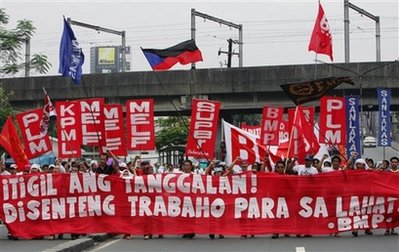
Itigil ang Tanggalan!

Itigil ang Tanggalan!
Disenteng Trabaho para sa Lahat!

kagutuman sa kabila ng kahirapan

kagutuman sa kabila ng kahirapan

Mga tagasunod

Slam Evil, Slam Apec

Slam Evil, Slam Apec
November 1996