Uring Manggagawa, Hukbong Mapagpalaya!

Sosyalismo ang Lunas! Ibagsak ang mapang-api't masibang kapitalistang sistema! Manggagawa sa Lahat ng Bansa, Magkaisa!

Miyerkules, Oktubre 19, 2016

President Duterte must condemn and punish cops who attacked protesters

President Duterte must condemn and punish cops who attacked protesters

We at the Bukluran ng Manggagawang Pilipino condemn the violent dispersal of the nonviolent protests of indigenous peoples belonging to the newly formed Sandugo alliance at the US embassy today and at Camp Aguinaldo yesterday.

Over fifty of our brothers and sisters were hurt when the police and the military used disproportionate force to break up their protest. Many were injured when a police vehicle repeatedly rammed the crowd of unarmed protesters.


This is shocking and unacceptable under any circumstances. But it is even more intolerable under a government that has promised to champion the rights of indigenous peoples and other oppressed classes, under a President who claims to be the first ‘leftist’ or ‘socialist’ President of the country.

As commander-in-chief of the country’s police and military, President Rodrigo Duterte has command responsibility over the state’s repressive forces. As such, he too is ultimately responsible for these forces’ actions.

To prove that he is committed to upholding our freedom to assemble and protest and to demonstrate that he supports our indigenous sisters’ and brothers’ struggle for their rights, he must immediately and publicly castigate the military and police officials responsible for this crackdown.

At the very least, he must immediately order disciplinary actions against—and if need be fire—Franklin Kho, the driver of the police vehicle that rammed the group of protesters and Marcelino Pedrozo, the officer who ordered the violent dispersal.

Any hesitation or refusal on his part to strongly denounce this shocking use of force will only further intensify the reigning climate of impunity that he has further fanned with his repeated pronouncements that he will protect and pardon all police officers accused of human rights violations.


It is this climate of impunity that is already leading officers of the law to think they can get away with anything—even attempted murder in front of cameras.


The struggle of the indigenous peoples is inseparable from our struggle as workers. An attack on them is an attack on us all.

Linggo, Oktubre 16, 2016

All Senators’ bills fail to challenge contractualization

All Senators’ bills fail to challenge contractualization

Below is the position paper on the Senate bills on contractualization and security of tenure of workers issued by the Bukluran ng Manggagawang Pilipino National Executive Committe on October 13, 2016:

The Bukluran ng Manggagawang Pilipino (BMP) welcomes various initiatives by lawmakers to address contractualization and other controversies regarding job security, in the form of legislative proposals to address a problem, which has long been branded by the organized labor movement as a scourge on labor rights and welfare.

But all the proposals, particularly Senate Bills 217 (Hontiveros), 174 (Aquino), 117 (Pimentel), 302 (Zubiri), 329 (Ejercito), 1061 (Poe), and 1116 (Villanueva), fail to address the legal basis for contractualization; no other than Articles 106 to 109 of the Labor Code, which pertains to contracting and subcontracting agreements.

As a workers’ organization, we are not composed of lawyers but of trade unionists who are day-to-day practitioners of laws on labor relations. But we all still know that provisions on job contracting undermine Article 280 of the said code, which states that regular employees are those who perform “usually necessary or desirable” in the normal operations of a business.

Articles 106 to 109 provides the loophole for the so-called “principals” in these trilateral agreements to use contractors and subcontractors that provide cheaper and more docile workers to carry out work that should be performed by their regular employees.

These provisions not only obfuscate employee-employer relationships. In the processes of union building, workers become victims of finger-pointing between principals and the labor agencies on who should negotiate with the newly-formed union regarding wages, benefits, and work conditions.

More so, these provisions reinforce the capitalist blackmail of “work or starve”, as the threat of unemployment constantly hovers, like Damocles’ sword, on contractual workers who could be fired anytime by simply terminating their employment contracts.

Contractualization, legalized by Articles 106 to 109 of the Labor Code, is tantamount to cheap and docile labor. It is a problem that affects millions, especially if we include the families who rely on casual workers for their daily sustenance and upkeep.

According to the May 2016 Labstat Updates of the Philippine Statistics Authority (PSA), based on the 2013/2014 Integrated Survey on Labor and Employment, out of a total of 4.472 million workers in firms with twenty (20) or more employees, 1.336 million (29.87%) are non-regular workers. This data does not include those employed in small and micro establishments, which comprise more than 90% of employers in the country.

If the 1.336 million contractuals in large firms provide for the needs of a family of five, we have 6.68 million Filipinos who are affected by low wages and the lack of job security due to contractualization!

Hence, the BMP believes that only a bill that would  repeal Articles 106 to 109 and the prohibit  contracting of “usually necessary or desirable” work, pursuant to Article 280 of the Labor Code would actually begin to bring an end to contractualization. Employment of contractual labor, in order to depress wages and deny regular status to workers should be regarded as a criminal offense.

Such harsh penalties, as proposed, are guided by state policies enshrined in the Constitution. Labor, states Article 2, Section 18, is the “primary social economic force”. Because labor should enjoy primacy over non-human inputs in production and commerce, the charter orders the state to provide “FULL PROTECTION to labor” (Article 13, Section 3, emphasis ours).

The State should guarantee workers their immutable rights in the work place – a fitting tribute to their undervalued contribution to economic development. It is hence but appropriate to treat the deprivation of the workers’ due, their basic entitlements and social protection as criminal transgressions which must not be countenanced by the State.

Indeed, the State owes a ballooning social debt to workers who should, as a matter of Constitutional mandate, be entitled to living wage, participation in decision-making processes affecting their rights and benefits, unhampered self-organization, among others.

Hence, the BMP challenges Congress to tread the right direction, consistent with this mandate, by plugging the legal loopholes that permit contractualization and the further detriment of labor rights and welfare.

Ending contractualization, which has been declared as a policy by no less than President Rodrigo Roa Duterte himself, is a step in this rightful course.

End contractualization now!


Uphold the right of workers to security of tenure!

Biyernes, Oktubre 14, 2016

BMP to Duterte: Fire Trade Secretary Ramon Lopez now


Duterte: Fire Trade Secretary Ramon Lopez now


During the election campaign, President Rodrigo Duterte won the hearts of many workers when he promised to immediately end “contractualization,” or the practice of not giving workers the wages and benefits they should receive under the law by hiring them as “contractual” rather than regular workers.


Then, during his inaugural speech, President Duterte said that his government will be guided in part by former US President Franklin Delano Roosevelt’s statement that, “The test of government is not whether we add more to the abundance of those who have much; it is whether we provide for those who have little.”
Today, one person in the President’s Cabinet has gone out of his way to prevent the President from fulfilling his campaign promise and from passing the test that Roosevelt set.

Since he assumed office, Department of Trade and Industry Secretary Ramon Lopez has consistently opposed measures to end contractualization that we at the Bukluran ng Manggagawang Pilipino, along with other labor groups in the country, have been demanding.


Recently, Lopez even championed the so-called “win-win” but in fact win-lose solution that purportedly seeks a middle-ground between capitalists and workers but in fact again ultimately harms the interests of workers since it will continue to force them to live a life of precarity and near-destitution while allowing the rich to earn more profits and live a life of luxury on the back of contractual workers.


Yesterday, he again spoke out to defend contractualization by saying that ending it would make the country less attractive to foreign investors by removing their “flexibility”—as if “flexibility” for investors has not come and will not come at the expense of the well-being of Filipino workers.

At every step of the way, then, Lopez and his department has represented not the interests of Filipino workers but of capitalists—Filipino and foreign. He fails the test that Roosevelt set because he wants to “add more to the abundance of those who have much” rather than “provide for those who have little.”

In so doing, he is challenging and defying President Duterte himself since the President has said that he wants to “provide for those who have little” and he has promised to end contractualization.

This, then, is an important moment for the President—another early test forcing him to choose whose side he will take and whose interests he will protect.


If the President really cares about Filipino workers, if he really wants to to “provide for those who have little,” then he should match his rhetoric with action and do what needs to be done: he should immediately fire those in his Cabinet who favor contractualization.

More than this, he should immediately take steps needed to end labor flexibilization once and for all by: 1) certifying as urgent – and mobilizing all his party mates to pass – a bill to amend Articles 106 to 109 of the Labor Code in order to prohibit the contracting and subcontracting of “usually necessary or desirable” work in the normal operations of a business, which should be performed by regular employees, in line with Article 280 of said law; 2) revising the BMBE law so as to remove the exemptions to labor standards compliance of small and micro establishments, which comprise more than 90% of the employers’ sector; 3) repealing DOLE’s DO 18-A and issuing a new order which reviews all existing subcontracting arrangements and cancels those that encroach upon the duties and functions, which should done by regular employees; 4) actually prosecuting employers that practice contractualization, starting with the Sys, the Ayalas, the Gokongweis and others.

Otherwise, if he allows the pro-contractualization Lopez to stay in his Cabinet and if he does not carry out all these steps immediately, it will become harder and harder for us not to confirm what many of us have long suspected but wanted the President to refute:


That he did not really mean what he said when he said he would end contractualization, that he does not really care for all Filipinos but just for his fellow elites, and that he will not really bring about real change—just like all his predecessors.

Workers group challenges Duterte to fire pro-contractualization Trade Secretary

Workers group challenges Duterte to fire pro-contractualization Trade Secretary

Socialist workers’ group Bukluran ng Manggagawang Pilipino (BMP) today called on President Rodrigo Duterte to fire his Trade and Industry Secretary Ramon Lopez.

Lopez has been defying and contradicting the President’s own campaign promise to end the practice of contractualization so the President must remove him from office if he is still serious about fulfilling his promise, BMP said.

The group was reacting to Lopez’s most recent statement saying contractualization will only scare away foreign investors.

“Since he assumed office, trade Secretary Ramon Lopez has consistently opposed measures to end contractualization,” the group noted in its statement.

“At every step of the way, Lopez has represented and defended not the interests of Filipino workers but of capitalists—Filipino and foreign. He fails the test that the President set because he wants to “add more to the abundance of those who have much” rather than “provide for those who have little,” the group added, quoting the President’s inaugural speech.

Expressing frustration at the lack of progress in eliminating contractualization, the group said the President needs to do more to demonstrate his commitment to workers by firing Lopez.

“This is an important moment for the President—another early test by forcing him to choose whose side he will take and whose interests he will protect.

If the President really cares about Filipino workers, if he really wants to “provide for those who have little,” as he said in his inaugural speech, then he should match his rhetoric with action and do what needs to be done: he should immediate fire those in his Cabinet who favor contractualization.”

In addition, the group called on the President to take concrete steps needed to end labor flexibilization. This include: 1) certifying as urgent – and mobilizing all his party mates to pass – a bill to amend Articles 106 to 109 of the Labor Code in order to prohibit the contracting and subcontracting of “usually necessary or desirable” work in the normal operations of a business, which should be performed by regular employees, in line with Article 280 of said law; 2) revising the BMBE law so as to remove the exemptions to labor standards compliance of small and micro establishments, which comprise more than 90% of the employers’ sector; 3) repealing DOLE’s DO 18-A and issuing a new order which reviews all existing subcontracting arrangements and cancels those that encroach upon the duties and functions which should done by regular employees.


Finally, the group challenged the President to actually prosecute employers that practice contractualization, starting with the country’s richest families such as Sys, the Ayalas, the Gokongweis and others.

Huwebes, Oktubre 13, 2016

Duterte’s foreign policy remains subservient, not independent

Bukluran ng Manggagawang Pilipino
PRESS RELEASE

Duterte’s foreign policy remains subservient, not independent

President Duterte's recent pronouncements regarding the country's relationship with the United States, China, and Russia does not signal an "independent foreign policy."

While the President’s criticism of our unequal relationship with the US is, of course welcome, the President himself has made it clear that he has threatened to break our subservient and mendicant relationship with the US only because the US officials have criticized the President's brutal "war on drugs."

This in itself does not constitute "independence."

Independence does not mean having the freedom to, in the President’s words, "happily slaughter" thousands of drug pushers or dependents. Independence does not mean renouncing our duties and obligations to humanity as responsible members of the international community.

Secondly, despite his repeated threats and bluster, the President has not actually abrogated the Mutual Defense Treaty, the Visiting Forces Agreement, the Enhanced Defense Cooperation Agreement, and other onerous deals that constitute the basis of our unequal and mendicant relationship with the US.

Despite his provocative words, he and his alter egos have repeatedly backtracked on his announcements that the Philippines will no longer conduct military exercises or cut our ties with the US altogether.

Clearly, if the President were serious about breaking with the US, he would have set the ball rolling for the repeal of the treaties mentioned earlier and stuck to his word regarding the military exercises.

But the fact that the President has not done so only lends credence to our fears that, first, he is only instrumentalizing legitimate concerns about our unequal relationship with the US in order to obscure and delegitimize criticisms of his violent, anti-poor, and ineffective “war on drugs”; and that, second, he is merely trying to extract even more concessions from the US while appearing to be critical of the US--just like what the former dictator Marcos did in the past.

Finally, we do not believe that the President favors an independent foreign policy because he only seeks to replace the “alliance” with the US with an alliance with other rising powers, namely China and Russia. Indeed, in line with this, he has even announced that the government would not press the Philippines' claim to the disputed Scarborough Shoal.

Instead of signaling an 'independent foreign policy,' this actually signals the beginning of yet another era of subservience--only this time, to a different or to a more varied set of masters.

For not only is China's commitment to human rights and international law questionable at best, China has also adamantly opposed just and peaceful solutions to the disputes in the region.

In this context, Duterte's refusal to even discuss the country's claim to the Scarborough Shoal is tantamount to sending China the message that it can just use its might and throw its weight around to bully everyone else into submission.

This will not only undermine efforts to arrive at a just and peaceful settlement to the dispute, such as proposals for equitably sharing the resources of the disputed area among the region's peoples, it could also effectively lock in the Philippines to a subordinate position vis-a-vis China.

Instead of breaking with the past and inaugurating a new era in our relations with other countries, then, Duterte seems to be paving the way for more of the same: Rather than independence, we see subservience; rather than sovereignty, we discern surrender.

In order to achieve real independence, we demand, among others, the immediate abrogation of the MDT, the VFA and he EDCA. We demand peaceful but just solutions to the disputes in the region. And we demand equal relations with all countries based on the spirit of genuine international brotherhood, economic cooperation, and mutual benefit.

Bukluran ng Manggagawang Pilipino
Contact persons:
Leody de Guzman, BMP President @ 0920-5200672
Atty. Luke Espiritu, BMP Spokesperson @ 0933-0417125

Miyerkules, Oktubre 12, 2016

Duterte’s foreign policy remains subservient, not independent

Duterte’s foreign policy remains subservient, not independent

President Duterte’s recent pronouncements regarding the country’s relationship with the United States, China, and Russia do not signal an “independent foreign policy.”

While the President’s criticism of our subservient and mendicant relationship with the US is of course welcome, the President himself has made it clear that his criticisms were only a response to US officials’ concerns about the President’s brutal “war on drugs.”

This in itself does not constitute “independence.”

Independence does not mean having the freedom to, in the President’s words, “happily slaughter” thousands of drug pushers or dependents. Independence does not mean renouncing our duties and obligations to humanity as responsible members of the international community.

Secondly, despite his repeated threats and bluster, the President has not actually abrogated the Mutual Defense Treaty, the Visiting Forces Agreement, the Enhanced Defense Cooperation Agreement, and other onerous deals that constitute the basis of our unequal and mendicant relationship with the US. 

Despite his provocative words, he and his alter egos have repeatedly backtracked on his announcements that the Philippines will no longer conduct military exercises or cut our ties with the US altogether.

Clearly, if the President were serious about breaking with the US, he would have set the ball rolling for the repeal of the treaties mentioned earlier and stuck to his word regarding the military exercises.

But the fact that the President has not done so only lends credence to our fears that, first, he is only instrumentalizing legitimate concerns about our unequal relationship with the US in order to obscure and delegitimize criticisms of his violent, anti-poor, and ineffective “war on drugs”; and that, second, he is merely trying to extract even more concessions from the US while appearing to be critical of imperialism.

Finally, we do not believe that the President actually favors an independent foreign policy because he only seeks to replace the “alliance” with the US with an alliance with other rising powers, namely China and Russia. Indeed, in line with this, he has even announced that the government would not press the Philippines’ claim to the disputed Scarborough Shoal.

Instead of signalling an ‘independent foreign policy,’ this actually signals the beginning of yet another era of subservience–only this time, to a different or to a more varied set of masters.

For not only is China’s commitment to human rights and international law questionable at best, China has also adamantly opposed just and peaceful solutions to the disputes in the region.

In this context, Duterte’s refusal to even discuss the country’s claim to the Scarborough Shoal is tantamount to sending China the message that it can just use its might and throw its weight around to bully everyone else into submission.

This will not only undermine efforts to arrive at a just and peaceful settlement to the dispute, such as proposals for equitably sharing the resources of the disputed area among the region’s peoples, it could also effectively lock in the Philippines to a subordinate position vis-a-vis China.

Instead of breaking with the past and inaugurating a new era in our relations with other countries, then, Duterte seems to be paving the way for more of the same: Rather than independence, we see subservience; rather than sovereignty, we discern surrender.


In order to achieve real independence, we demand, among others, the immediate abrogation of the MDT, the VFA and he EDCA. We demand peaceful but just solutions to the disputes in the region. And we demand equal relations with all countries based on the spirit of genuine international brotherhood,  cooperation, and mutual benefit.

Biyernes, Hulyo 1, 2016

Security of Tenure, Workers’ Rights and Welfare are non-negotiable

PRESS STATEMENT
July 1, 2016
Leody de Guzman (09205200672)
National President, Bukluran ng Manggagawang Pilipino (BMP)

Security of Tenure, Workers’ Rights and Welfare are non-negotiable:
No to a mere cap to ‘endo’
Yes to “Change is Coming”

In reaction to an earlier pronouncement by incoming Labor Secretary for limiting the employment of contractual labor to twenty percent (20%), the Bukluran ng Manggagawang Pilipino (BMP) would like to remind Silvestro Bello III that the workers’ rights and welfare are non-negotiable. 

We likewise oppose the blackmail line of “contractual employment or hunger by joblessness” that are issued by employers’ groups on the issue of contractualization. 

Our position is based on the following premises:

1) Placing a cap on contractual labor is not in the Labor Code, which clearly states that “usually and necessary labor” in the operations of a business should be performed by a regular employee (Article 280). It defines usually and necessary as the type of work performed for at least a year, whether continuous or broken. 

2) Bello’s proposal is likewise contrary and violative to the Constitution. While seemingly enabling the Constitutional right to security of tenure to a sizeable majority (80%) of the workforce, it institutionalizes its denial to two out of ten workers (20%). Where is the so-called “equal protection of law” in this patently anti-labor scheme?

3) The proposed cap on contractual labor is contrary to the “change is coming” mandate of the incoming Duterte administration. We want change. We want a labor market where workers’ rights and welfare are not threatened by contractualization. We expect it from a government that would side with the labor against capital, with the oppressed against the oppressors. Fence-sitting would not lead to change, it is business-as-usual for the unjust status quo. Bello must be reminded that the Duterte presidency rode on the crest of the people’s clamor for change by launching an all-out tirade against social ills, especially the lackluster and bungling elitist administration of Noynoy Aquino.

4) Putting an end to contractualization is not just a legal question on the Constitutional right to job security but a life-and-death issue for workers are forced to become cheap and docile due to the threat of unemployment, and in order for capital to gain higher profit margins. It is nothing but shameless and callous profiteering

Meanwhile, we condemn employers’ groups that justify contractualization by saying that it contributes to job generation. Your condescending excuses mock the dignity of labor. You are not in the business of providing us jobs to feed our families. Accumulation and competition are your masters. In their service, you have installed this regime of precarious and contractual work, that imposed starvation wages on hardworking Filipinos.

Mr. Sergio Ortiz of the Philippine Chamber of Commerce and Industry (PCCI) has correctly observed that combatting contractualization would be hard due to the high levels of unemployment. Of course, cut-throat competition among workers to sell their labor-power persists as long as the unemployed masses lines up at the factory gates. But it is precisely the reason why the Philippine state – abiding by its Constitutional mandate to provide full protection to labor – should uphold the interests of the workers lest they fall prey to the blackmail line of “low wages or hunger” by exploitative employers. 

Hence, we appeal to the incoming Duterte administration to be true to its mandate by implementing the harshness of the law on abusive capitalists in the same way that it now threatens the crime lords of the illegal drug trade. For an Executive Order against contractualization! Prohibit the contracting out of “usually necessary and desirable work”! Amend Articles 106 to 109 of the Labor Code! #

Seguridad sa Trabaho, Karapatan at Kagalingan ng Manggagawa ay Hindi Naaareglo:

Hindi sa simpleng panakip lang sa ‘endo’
OO sa “Pagdating ng Pagbabago” 

Bilang tugon sa maagang pahayag ng papasok na Kalihim ng Paggawa sa paglilimita ng pagtatrabaho ng kontraktwal na paggawa sa dalawampung bahagdan (20%), nais ipaalala ng Bukluran ng Manggagawang Pilipino (BMP) kay Silvestre Bello III na hindi naaareglo ang karapatan at kagalingan ng manggagawa.

Gayundin naman, tinututulan namin ang linyang panggigipit na “trabahong kontraktwal o kagutuman sa kawalan ng trabaho” na ipinahayag ng mga pangkat ng kapitalista hinggil sa isyu ng kontratwalisasyon.

Ang aming tindig ay batay sa sumusunod na mga kadahilanan:

1) Ang paglalagay ng panakip sa kontraktwal na paggawa ay wala sa Kodigo ng Paggawa, kung saan malinaw na nakasulat ang “karaniwan at kinakailangang paggawa” sa pagpapatakbo ng isang negosyo ay dapat gampanan ng isang regular na empleyado (Artikulo 280). Ipinaliliwanag nito ang karaniwan at kinakailangan bilang tipo ng paggawang ginagampanan sa loob man lang ng isang taon, ito man ay tuluyan o patlang-patlang.

2) Gayunman, ang panukala ni Bello ay salungat at labag sa Saligang Batas. Habang nakikitang nagagampanan ang Konstitusyonal na karapatan sa seguridad sa trabaho sa malawak na mayorya (80 bahagdan) ng pwersa ng mga nagtatrabaho, itinatatag nito ang pagkakaila sa dalawa sa sampung manggagawa (20%). Nasaan ang tinatawag na “pantay na karapatan sa batas” sa ganitong malinaw na pakanang laban sa paggawa?

3) Ang panukalang panakip sa kontraktwal na paggawa ay salungat sa mandatong “parating na ang pagbabado ng parating na administrasyong Duterte. Nais namin ay pagbabago. Nais namin ang isang merkado ng paggawa kung saan ang karapatan at kagalingan ng manggagawa ay hindi pinagbabantaan ng kontraktwalisasyon. Ang inaasahan namin sa isang pamahalaan ay ang pagpanig nito sa paggawa laban sa puhunan, sa panig ng inaapi laban sa mga mang-aapi. Ang pangingitlog sa bangko ay hindi tutungo sa pagbabago, ito’y karaniwang-pagnenegosyo-lang para sa mga di-makatarungang naghaharing kairalan. Dapat paalalahanan si Bello na ang panguluhang Duterte ay nakatungtong sa gulugod ng panawagang pagbabago ng sambayanan sa pamamagitan ng paglulunsad ng panlahatang panunuligsa laban sa mga sakit ng lipunan, lalo na ang  walang kinang at padaskul-daskol na elitistang administrasyon ng Noynoy Aquino.

4) Ang pagwawakas sa kontraktwalisasyon ay hindi lamang isang legal na usapin ng Konstitusyonal na karapatan sa seguridad sa trabaho subalit isang usaping buhay-at-kamatayan para sa mga manggagawang natutulak na maging mura at masunurin dahil sa banta ng kawalan ng trabaho, at upang makakuha ng mas mataas na tubo ang puhunan. Wala ito kundi kawalanghiyaan at kawalang-habag na pagkakamal ng tubo.

Samantala, kinukundena namin ang mga grupo ng kapitalistang binibigyang matuwid ang kontraktwalisasyon sa pamamagitan ng pagsasabing nakapag-aambag ito sa pagkakaroon ng trabaho. Ang pagpapakumbabang pagdadahilan ninyo ay mapangutya sa dignidad ng paggawa. Wala kayo sa katwirang bigyan kami ng trabaho upang mapakain ang aming pamilya. Ang pangangamkam at kumpetisyon ang inyong mga amo. Sa pagsisilbi sa kanila, inilagay ninyo ang rehimeng ito ng trabahong mabuway at kontraktwal, na iginigiit ang sahod na nakagugutom sa mga matitiyagang Pilipino.

Wastong naobserbahan ni Ginoong Sergio Ortiz ng Philippine Chamber of Commerce and Industry (PCCI) na ang pagbaka sa kontraktwalisasyon ay mahirap dahil sa taas ng antas ng kawalan ng trabaho. Siyempre, ang mga mapanakal na kumpetisyon sa mismong mga manggagawa upang ibenta ang kanilang lakas-paggawa ay nagpapatuloy habang parami ng parami ang mga walang trabahong manggagawa sa tarangkahan ng mga pabrika. Ngunit ito ang tiyak na rason kung bakit ang estado ng Pilipinas – na sumusunod sa mandatong Konstitusyonal nito na bigyan ng buong proteksyon ang paggawa – ay nararapat panindigan ang interes ng mga manggagawa kung hindi’y mabibiktima sila ng palyadong linyang “mababang sahod o gutom” ng mga mapagsamantalang kapitalista.

Kaya, nananawagan kami sa parating na administrasyong Duterte na maging totoo sa mandato nitong ipatupad ng malupit ang batas hinggil sa mga abusadong kapitalista sa parehong paraan na sa ngayon ay pinagbabantaan ng mga panginoon ng krimen ng mga ilegal na kalakalan ng droga. Para sa isang Batas Ehekutibo laban sa kontraktwalisasyon! Ipagbawal ang pangongontrata ng “paggawang karaniwang kinakailangan at kalugod-lugod”! Amyendahan ang mga Artikulong 106-109 ng Kodigo ng Paggawa! #

May 1, 2013 rali

Das Kapital published on 14 Sept 1867

Das Kapital published on 14 Sept 1867

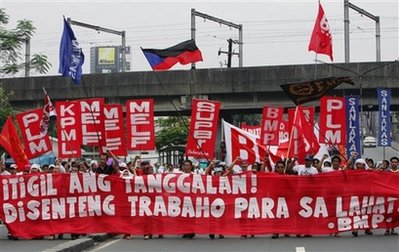
Itigil ang Tanggalan!

Itigil ang Tanggalan!
Disenteng Trabaho para sa Lahat!

kagutuman sa kabila ng kahirapan

kagutuman sa kabila ng kahirapan

Mga tagasunod

Slam Evil, Slam Apec

Slam Evil, Slam Apec
November 1996