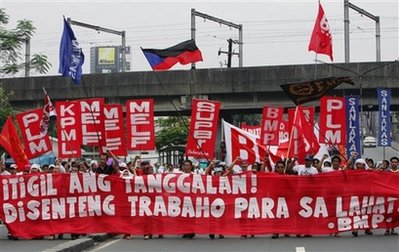
CAMPAIGN
FOR LABOR PROTECTIONISM
for
Social Progress and Social Justice in the 21st century
Bukluran
ng Manggagawang Pilipino (BMP)
March
2014
The 1987
Philippine Constitution affirms the role of labor as the "primary social
economic force" in its declaration of principles and state policies.
Constitutionalist Fr. Joaquin Bernas defines this provision as the primacy of
the human factor over non-human factors in production.
In its
section for social justice and human rights, the highest law of the land
declares that "the state shall afford full PROTECTION TO LABOR".
Consistent with its recognition to labor's importance to society and the
economy, it also orders the state to "promote full employment and the
equality of equal employment opportunities for all".
By full
"PROTECTION TO LABOR", the Charter guarantees the following rights of
all workers: (a) self-organization, (b) collective bargaining and negotiations,
(c) peaceful concerted activities including the right to strike.
Workers are also entitled to "security of tenure, humane conditions of
work, and a living wage", along with their "just share in the fruits
of production".
Wholesale
Infringement of Labor Rights and Standards
However, the
condition of the Filipino working class, under successive post-EDSA 1986
governments, is not reflective of the letters and spirit of the 1987
Constitution. Not only are workers not fully protected by law against
capitalist abuse. More so, the state
itself restricts the rights of labor through its own anti-worker, anti-poor
policies and legislation.
·
Rather than "full employment", the unemployed and
underemployed are wasted by joblessness while the few employed are compelled to
go on overtime to augment their meager income;
·
Instead of "self-organization" and "collective
bargaining", labor groups are threatened to extinction by
contractualization and stringent mechanisms that hinders union recognition;
·
As to the right to "concerted activities including the right
to strike", unions are ordered by the Labor Secretary to return to work
even as they have only filed a strike notice and have not yet attempted any
temporary or permanent work stoppage. The "assumption of
jurisdiction" powers of the Secretary of Labor infringe the right to
strike;
·
Sweatshop labor remains in the country in an era of unprecedented
discoveries and technological advancements;
·
Workers receive not the living wage, but starvation wages. The
country's wage fixing mechanisms favor "employers capacity to pay"
rather than the workers' cost of living in determining the price of
labor-power; and,
·
Instead of enjoying their "just share" in the fruits of
production, there is no substantial betterment to the lives of workers and
their families as it is eclipsed by their immense contributions to social
progress. Benefits and labor standards have remained stagnant throughout the
years despite the great leaps to global production and economic growth in the
last fifty years of the 20th century.
Neoliberalism and the
Global Capitalist Offensive against Labor
The erosion
of labor rights and standards in the Philippines is part of a global capitalist
offensive that gained steam in the last decade of the new millennium.
It is an
ongoing onslaught that has been described - even by conservatives in the labor
movement* - as a "virtual holocaust" of unionism. Around the world,
employers are taking away the hard-won victories of the international trade
union movement. Capital wants to turn back time by two centuries, to a return
to 19th century labor-capital relations, when labor rights and standards were
not legally-enforced and where unions were forcibly outlawed.
In its
crusade against unionism, capitalists raise the banner of "free
trade" and the economic doctrine of neoliberalism. They say protectionism
is obsolete in the era of globalization. What we need now, they argue, is the
removal of all state interventions in the market through the policies of
liberalization, deregulation, privatization and flexibilization of labor.
Successive
post-Edsa 1986 administrations toed the neoliberal line, without an iota of
doubt and reservation. In the 1990s, the Philippine government started selling
state-owned public utilities (water, power plants) to foreign-backed local
taipans. It also dismantled regulatory mechanisms for petroleum products and
the entire oil industry.
At the labor
front, omnibus amendments to the Labor Code in 1987 changed the rules for
security of tenure and wage-fixing (among other provisions). Previously fixed
labor standards are being removed in line with the dictum of "labor
flexibility".
The infamous
Herrera-Veloso Law (RA6715) overhauled the 1974 Labor Code (Presidential Decree
442). One of its amendments explicitly stated that regular employees cannot be
terminated without just cause (Article 279). Its deafening silence on the
removal of casual workers for unjust arbitrary reasons became a gaping legal
loophole that legitimized the capitalist threat of unemployment to casual
workers.
Amendments
to wage-fixing was also enacted through the Wage Rationalization Act (RA6727)
established regional minimum wages and tripartite wage boards. Its criteria for
wage-fixing undermined the Constitutional guarantee to a living wage.
These laws
(RA6715 and RA6727), alongside other Labor Code provisions on regular and
casual employment (Article 280) and legitimate and illegitimate contracting
(Article 106), laid the legal foundations for contractualization, a scourge
that continues to wreck havoc on the Constitutional rights to job security
through regular employment, to self-organization for collective bargaining, and
to decent life through a living wage.
Through
these anti-worker legislations – implemented through subsequent labor
department orders, a cheap, docile – and mostly contractual labor force – was
created in a span of two decades.
At the same
period, however, both at the global and local levels, the bankruptcy of
neoliberalism became too glaring to dismiss.
Once
proclaimed in the 1990s as the new paradigm for economic development, it is now
exposed for its subservience to corporate greed, to monopoly capital, to large
banks and to transnational corporations. The damning evidence against it is
none other than the 2008 global financial crisis brought by the liberalization
of global finance and rivaled only by the 1929 Great Depression in scope and
magnitude.
In the
Philippines, privatization and deregulation brought spiraling power rates.
Meralco's $0.24/kwh is the fifth highest in the world and the most costly in
Asia. The promise of cheap but better services by the water concessionaires
remains unfulfilled. Local oil prices, whose movements do not correspond with
world prices, are generally-accepted as proof for monopoly pricing by the
cartels. The reduction of tariffs to hasten the entry of foreign products in
the country has resulted into the collapse of domestic manufacturing,
particularly our garments and textile industry.
Focusing and
Extending the Militant Workers' Struggle
on Matters of State
Policy and in the Parliamentary Arena
This
holocaust against unionism is a product of both corporate choice and economic
law. The imperative from the perspective of labor, is to preserve, as an
initial step, its historic gains in more than a century of workers struggle,
protect the workers basic rights and promote their general welfare, and adapt
the struggle to the current complexities of labor-capital relations in this era
of globalization and neoliberalism.
By its very
nature, this self-defense struggle of labor against capital's predatory
aggression, must focus on state policy and inevitably extend on the legislative
arena. In the first place, how can workers defend themselves at the enterprise
level when the overwhelming majority are not even unionized and are deprived of
the right to collectively bargain. On the other hand, separate struggles of
individual unions will only benefit their particular members. Besides, it can
only do so much since many current labor problems are not independent corporate
decisions but are dictated by general economic developments and state policies.
The struggle, therefore, must take a political character. A struggle on matters
of state policies must be fought in the parliamentary arena. And this struggle
must take a generalized character - a unified struggle of the entire working
people.
Secondly,
landmark victories of the labor movement - the right to unionize, the right to
strike, the 8-hour workday, labor standards and benefits - were all won not in
separate battles at the enterprise level but class war in the political arena.
They are concessions of the capitalist state and (these) legislative victories
and advances in workers' rights and welfare are being undermined and attacked
by the forces and power of capital. In due time, the economic laws and
corporate choices will all find expression in state policies and legislations
and complete the legalization of capital's offensive against labor.
The labor
movement has no choice but to combine mass struggle with parliamentary struggle
in the political arena just as it combines direct mass action with tactics in
bargaining negotiations at the enterprise level. The militant section of the
trade union movement must renounce its "heritage" of recoiling from
the parliamentary arena, while simply engaging the capitalist state in
propaganda battles and not doing its very best in fighting for tangible
victories.
Campaign for
"Labor Protectionism"
Protectionism
is the anti-thesis of neoliberalism. It argues for state intervention in the
market as it places primacy to the "right to live decently" over
property rights. With regards to promoting workers' rights and welfare, we are
calling for a policy shift towards "labor protectionism" in
accordance to the Constitutional provision for providing "full protection to
labor".
To
materialize the policy of "labor protectionism", the following
demands would be expanded into concrete, detailed and formal legislative
proposals:
1. Enable
the Constitutional guarantee for a living wage. Reform wage-fixing mechanisms
by setting the daily cost of living as the sole criterion of the minimum wage
or take-home pay. Enact a "living wage" law. Abolish the regional
wage boards and create a Living Wage Commission to take the responsibility of
mandating wage increases.
Exempt from
income tax and paying their Social Security System (SSS) or GSIS, Pag-ibig and
Medicare contributions all fixed-income earners with wages and salaries not
exceeding the daily cost of living. Increase take-home pay through tax breaks.
2. Adopt a
36-hour workweek (six-hour working day, 6 days a week) to enable the
Constitutional provision for "full employment". Increase the overtime
premium to 60%. Set a maximum allowable daily overtime work of four (4) hours.
3. Combat
the menace of contractualization and casualization with comprehensive pro-labor
legislation. This epidemic spawned by globalization is proving to be Enemy No.
1 of the labor movement. Capitalists resort to varied forms of
contractualization and casualization to bust or ban unions, cheapen labor and
deny labor security. Increase the payment of contractual labor to 200% of the
minimum wage.
4.
Liberalize requirements and hasten process of union building. Remove the
"no union" option in certification election because Constitutional
rights could not be waived. Direct and mandatory recognition for unions in
unorganized establishments (Article 257, Labor Code as amended by Republic Act
9481). Enact a comprehensive labor code for public sector unionism and laws and
guidelines for the building of national unions specially in industries or
sectors where local unions are impractical.
5.
Criminalize labor law violations by capitalists, particularly on compensation,
labor standards, ULP and union busting, in accordance with the last paragraph
of Article 248. They should be penalized with imprisonment and fines. Establish
special labor courts to handle these criminal cases in continuous trial.
6. Shorten
the term of a collective bargaining agreement to three (3) years with yearly
renegotiations on its economic provisions to ensure its timeliness.
7. Reform
and reorganize the Department of Labor and Employment (DOLE) and National Labor
Relations Commission (NLRC) as graft-ridden government agencies manned by
officials and bureaucrats beholden to capital. Fast track resolution of cases
filed by labor through continuous hearings and restrict management's abuse of
"due process". Decisions at the commission level should be
immediately executory. Appeals to NLRC decisions should be brought directly to
the Supreme Court.
8.
Prioritize workers' claim over government and other creditors in the event of
permanent shutdown of a company. Enact law obliging companies to establish
trust funds for retirement, severance, gratuity and separation pay of workers.
Make more effective laws prohibiting and penalizing run-away shop, illegal
lockout, illegal closure, illegal shutdown, illegal dismissal and all matters
related to unfair labor practice and union-busting.
9. Amend
provisions of jurisdiction on strikes. The Labor Secretary can regulate but not
deny through his "assumption" powers the constitutional right of
workers to strike even in "vital industries". He should be allowed to
assume jurisdiction only at a particular stage of a strike. Once the Secretary
assumes jurisdiction, he should resolve all disputes and stop the practice of
certifying to the NLRC a labor dispute assumed by the DOLE. Legalize the right
of strikers to block ingress-egress of goods and personnel during a strike.
Strengthen anti-scab provisions and restrict the hiring of striker replacement.
10. Deputize
labor leaders and trade unionists as "labor inspectors" to monitor
and report violations of labor laws and standards. Establish an Ombudsman for
Labor to investigate and prosecute corrupt government officials and trade union
leaders. Establish a Labor Investigation Bureau (National Bureau of
Investigation-NBI type) to assist workers and unions in the investigation and
prosecution of labor related violations.
The Path to Genuine
Social Progress
is Social Justice for
the Working Class
Our demand
for meaningful reforms in labor relations is guided by the concept of
"social justice". In accordance with the Charter’s provisions on
social justice and human rights, these proposals seek to: a) protect and enhance
the right of workers to human dignity, b) reduce social, political and economic
inequalities and c) remove the cultural inequities, by equitably diffusing
wealth and political power for the common good.
To attain
these objectives, the Constitution shall regulate property rights,
contrary to the capitalist dictum in the era of neoliberalism and globalization
that regards management and company prerogative as absolute.
This
proposed labor legislative agenda is an answer to the undeniable gap between capital
and labor, the rich and the poor, the propertied and the have-nots that exists
in the country today despite the steady annual growth of the Philippine economy.
·
In 2011, the richest 40 families accounted for seventy six (76%)
of the Philippine gross domestic product (GDP).
·
The top three deciles – according to family income distribution –
enjoy P2.43 Trillion or almost sixty four percent (63.8%) of the total family
incomes in the country.
·
Henry Sy, who recently crashed in the Forbes list of 100 richest
people in the world,
attained his iconic status through cheap contractual labor.
The widening
gap between the affluent and the impoverished exists not only in the country.
It is a global trend, aggravated by the policies of neoliberalism and by
undeniable advancements in the social production.
Global
production in the last five decades of the previous century surpasses the
accumulated labor of the past 10,000 years before World War 2. Yet, all around
the world, wages paid to chief executive officers of transnational corporations
are almost four hundred times more than their average worker.
The slogan of the renowned “Occupy Wall Street” movement best captures the
present state of global inequality: “We are the 99%!”
For the working
class, genuine social progress means social justice. It means more than
economic growth and wealth creation, measured by the increase in GDP
and GNP.
It implies the redistribution of wealth to the toiling and impoverished
majority.
Progress means
the advancement in the living conditions of the people. For labor, this means
not just improvements in their material well-being – through wages, benefits
and ample opportunities for productive and gainful employment – but also in
their development as human beings and as members of society, i.e., to
participate in governance because the working class comprises the majority of
the sovereign Filipino people.
The defense
of labor rights and standards is but an initial step in redefining social
relations in the twenty-first century. Its requirement is a unified labor
movement that recognizes the shared predicament of all workers under
neoliberalism and globalization, and seeks meaningful and lasting improvements
for the next generation of the working class and the Filipino people.
To this end,
the BMP – through its allies in Congress and in the parliament of the streets –
would campaign for “labor protectionism”, commencing on Labor Day this year. We
are inviting the leaders of the broad trade union movement – from moderate to
militant – to discuss and draft a common legislative agenda to address the
everyday problems of the working class.
Inasmuch as
we challenge ourselves to the daunting task of revitalizing the militant labor
movement through these demands, we likewise dare the Noynoy Aquino
administration to address the worsening plight of Filipino labor by adopting
the policy of “labor protectionism”, in line with his unceasing rhetoric of “kayo ang boss ko” and “tuwid na daan”. #