Uring Manggagawa, Hukbong Mapagpalaya!

Sosyalismo ang Lunas! Ibagsak ang mapang-api't masibang kapitalistang sistema! Manggagawa sa Lahat ng Bansa, Magkaisa!

Lunes, Hulyo 26, 2010

BMP press release on P-Noy's 1st SONA

Bukluran ng Manggagawang Pilipino (BMP)
Press Release
July 26, 2010

Multitudes of actions, agenda challenged
by various sectors greeted P-Noy SONA

As early as 7am to 10am, various sectors converged in various points as a prelude to P-Noy SONA in the afternoon. Thousands of urban poor belonging to Kongreso ng Pagkakaisa ng Maralitang Lungsod (KPML) and allied organizations trooped in front of NHA along elliptical road and delegations to the house of P-Noy at times street in Quezon City. In the same mode, workers belonging to the Bukluran ng Manggagawang Pilipino (BMP) prominently displayed their slogans and streamers along Philcoa leading to Commonwealth avenue.

These groups later joined the converging point of the multisectoral group Sanlakas and its allied organizations in front of the office of Commission on Human Rights along Commonwealth Avenue at around 11am. The groups were also joined by other sectors and organizations to which their number swelled to thousands. They were carrying dialogue cum slogans imprinted in their placards as a way of ventilating their issues and agenda to the 1st SONA of the P-noy administration. A short program was held and around past 12:00 noon, the group marched to Tandang Sora where a huge contingent of Freedom from Debt Coalition (FDC), Philippine Alliance of Human Rights Advocates (PAHRA), KONTRA (Koalisyon Kontra Kontraktwalisasyon) members converged. At around 1:00 pm, the rallyists pursued marching down to Ever Gotesco but were joined by members of KAMP, a multisectoral alliance along the stretch of Pure Gold in Commonwealth.

The Sanlakas bloc presented a 10 pt. agenda where they articulated that these issues were the embodiment of the program to compliment Noynoy’s assertion of serving to his Boss, the Filipino people.

“P-Noy should pursue a program that would essentially address the issue of poverty and joblessness. If he is sincere in solving these concrete problems he must not use the former administration as a scapegoat but instead come up with a real solution to alleviate people’s misery. He has to touch the debt servicing issue in order to find ways for more funds for his pro-poor programs and services. He has to enhance the domestic economy to ensure jobs for the Filipinos. If he can do this, then he is not another Gloria in the making whose regime was attributed with politicking, corruption and heavy taxation.” Leody De Guzman, BMP President elaborated in an interview. (30)

Huwebes, Hulyo 15, 2010

Hamon ng Manggagawa kay P-Noy

HAMON NG MANGGAGAWA SA BAGONG ADMINISTRASYON AT PANGULO:

PROTEKSYON SA PAGGAWA

Sa siyam na taon ni Gloria Macapagal-Arroyo sa Malakanyang, lalong naghirap ang kabuhayan ng manggagawang Pilipino at lumala ang paglabag sa mga pantaong karapatan ng manggagawa. Hindi nito pinakinggan ang boses ng paggawa at konstitusyunal na karapatan ng mga manggagawang Pilipino.Na: Nasasaad sa Art. 13, Sec. 3 ang mga deklarasyon at katagang. . . “The State affirms labor as a primary social economic force. It shall protect the rights of workers and promote their welfare”. “The State shall afford full protection to labor, local and overseas, organize and un-organize, and promote full employment and equality of employment opportunities for all.” “It shall guarantee the rights of all workers to; Self Organization, Collective Bargaining and Negotiations, Peaceful Concerted Activities, including the right to Strike in accordance with law. “They shall be entitle to; Security of Tenure, Human Conditions of Work, and a Living Wage. “They shall; Participate in Policy and Decision Making Processes Affecting their Right and Benefits. “The State shall regulate the relation between workers and employers, recognizing; the right of labor to its just share in the fruits of production. Ngayong may bago ng pangulo, bagong administrasyon, narito ang hamon natin sa administrasyon ni P-Noy:

1. SEGURIDAD SA TRABAHO

Problemang malaki ang laging end contract ng trabaho tuwing 5 buwan. O kaya ay ipapasa sa isang contractor ang trabaho sa mababang halaga ang pasweldo at benepisyo sa contractor o subcontractor. Nawala ang security of tenure ng manggagawa. Di rin makapagtayo ng union at makabuo ng CBA dahil nga kontraktwal. Karamihan sa kontraktwal ay di natatamasa ang mga mandatory benefits gaya ng SSS, PhilHealth atbp. At pag muling nag-aplay ng trabaho gagastos na naman ng di bababa sa P2,500.00 sa mga requirements. Dagdag pa, pinauso na din ng mga employer ang Agelimit sa pagtanggap ng empleyado (18-23 years old) ang tinatanggap. Ang mga 23 years old pataas ay nawawalan na ng opportunidad na matanggap pa sa trabaho. Ang iba naman dahil sa re-contract ng re-contract sa empleyo tumatanda walang benepisyon matatamasa.

Gawa yan ng labor-only contracting (LOC) na pinauso ng mga kapitalista na naglipana sa kasalukuyan. Mga manpower o recruitment agencies na nagsusuplay ng empleyado sa mga kumpanya, kabilang dito ang trabahong janitorial at security. Paglabag yan sa Artikulo 106 at 280 ng Labor Code. Labag din sa Konstitusyon ng Pilipinas Artikulo 13, Seksyon 3 xxx. Dapat na may karapatan sila [manggagawa] sa katatagan sa trabaho.xxx Dahil sa walang itinakdang parusa sa mga lumalabag, nagpapatuloy ito na kinukunsinti ng mga opisyal ng gubyerno.

Solusyon sa problema:
1.1. Alisin ang Age Limit (18-25 years old) na pinauso ng mga kapitalista. Ganap na ipagbawal ang labor-only contracting at iba pang tipo ng kontraktwalisasyon at parusang multa at pagkakulong sa mga lalabag dito.

1.2. Alisin ang preventive suspension na karaniwang ginagawa ng kumpanya sa manggagawang
pinaghihinalaang nagkasala. Pinarurusahan na agad ang di pa napatutunayang nagkasala.

1.3. Direct Hiring ng nangangailangang kumpanya; walang dadaan sa agency. Gawing regular employee sa ikaanim (6) na buwan ng pagtatrabaho sa mga karaniwan, natatangi at kinakailangan sa arawang negosyo ng kompanya.

2. MAKABUBUHAY NA SAHOD AT BENEPISYO
Problemang malaki ang kaliitan ng sahod. Di magkasya kahit 16 na oras kang magtrabaho. Pinag-ibaiba pa ng mga Regional Wage Boards ang sweldo sa iba’t-ibang lugar. Maliit nga ang sweldo kaya di nakakapag-ipon para sa pagtanda. Iilang kumpanya lang ang may retirement pay o separation pay para sa kanilang empleyado. Ang iba naman ay tumatakas matapos isara ang kumpanya. Naiiwanang walang nakuhang benepisyo ang manggagawa. Kaya ang mga manggagawang nagpayaman sa kumpanya ay parang kalamansi na itinapon matapos sipsipin ang katas nito. Di nasusunod ang karapatan ng manggagawa na sinasabi sa Artikulo 13, Seksyon 3 ng Konstitusyon xxx Dapat may karapatan sila…..sa sahod na sapat ikabuhay.xxx

Ang solusyon sa problema:
2.1.Isabatas ang living wage o sweldong makabubuhay ng pamilya. Tanggalin ang mga Regional Wage Boards at ibigay sa Kongreso ang pagtatakda ng living wage sa buong bansa batay sa consumers price index.

2.2. Isabatas ang paglalagay ng Trust Fund para sa retirement pay, separation pay ng manggagawa. Para hindi na maulit ang nangyari sa NPI, Gelmart at maraming iba pa.

2.3. Isabatas ang unemployment insurance sa mga mawawalan ng trabaho para may pambuhay sa pamilya habang naghahanap ng panibagong trabaho.

2.4. Sa kalagayan ng pagsasara ng kumpanya at pagtakas ng may-ari sa mga pampinansyang
Responsibilidad nito sa mga manggagawa, aakuin ng gubyerno ang responsibilidad.

3. MAKATAONG KALAGAYAN SA PAGTATRABAHO
Maraming employer ang lumalabag sa Minimum wage law, di sumusunod sa Labor Standard Law at health and safety. Di na nga sapat ang minimum wage, di pa sinusunod ng maraming employer kaya naman kulang sa nutrisyon ang pamilyang manggagawa. Bukod pa, delikado sa kalusugan at kaligtasan ang maraming pagawaan na nagdulot ng malalang pagkakasakit at kamatayan. Bukod pa sa pagkasira ng kapaligiran. Di nasusunod ang karapatan ng manggagawa na sinasabi sa Artikulo 13, Seksyon 3 ng Konstitusyon xxx Dapat magkaroon sila ng karapatan sa makataong mga kalagayan sa trabaho xxx

Solusyon sa Problema:
3.1. Isabatas ang kaparusahang multa at pagkakulong sa mga employer na di tumutupad sa Labor Standard Law at health and safety.

3.2. I-deputized ng Department of Labor and Employment ang mga lider manggagawa bilang inspector ng Labor Standard at Health and Safety sa mga kumpanya.

3.3. Pahigpitin ang inspeksyon sa mga bago at dati ng kumpanya na nagbubuga ng nakakalasong usok at likido na sanhi ng maraming sakit ng manggagawa at pagkasira ng kapaligiran.

4. GANAP NA KALAYAAN SA PAG-OORGANISA, PAKIKIPAGTAWARAN AT SAMA-SAMANG PAGKILOS
Problemang malaki ang AJ o Assumption of Jurisdiction ng Secretary of Labor. Ito ay may terror effect sa mga manggagawa, unyon at kilusang paggawa kagaya ng nangyari sa Hacienda Luisita, Nestle Phils, Niukko Material Phils. at marami pang iba. Lahat ng konstitusyunal na karapatan ng manggagawa sa ilalim ng social justice provision ng konstitusyon ay nilalabag ng AJ pati ang likas na karapatang mabuhay. Paglabag ito sa karapatang pantao at di konstitusyunal. Ang pakikialam ng management sa pagtatayo ng unyon at iba pang aktibidad ng unyon ay sagabal sa mabilis na pagtatayo at pagdami ng unyon. Humahantong ang pakikialam ng management sa pananakot, pagtanggal sa trabaho at pagpatay ng lider. Ang simpleng pakikialam ng management ay paglabag sa Artikulo 246, 248 at 277 ng Labor Code.

Dahil sa walang takdang parusa, nagpapatuloy ang ganitong gawain ng management. Kapag walang unyon, di nakakakuha ng mas malaking sahod at benepisyo ang manggagawa. Ang manggagawa sa ngayon ay nakagapos ang kamay kapag kailangan nitong labanan ang pang-aapi at pambabarat ng mga kapitalista sa sweldo at benepisyo. Ito’y dahil sa sari-saring requirements at mahabang proseso bago makapagwelga. Problema din ang kapos na kaalaman ng napakaraming manggagawa sa kanilang mga karapatan bilang manggagawa at mamamayan.

Solusyon sa problema:
4.1. Alisin ang (Art. 263 (g) sa labor code) Assumption of Jurisdiction ng Kalihim ng Paggawa at Empleyo dahil niyuyurakan nito ang mga karapatang nakasaad sa Konstitusyon ng Pilipinas pati na ang karapatang mabuhay ng mga manggagawa.

4.2. Isabatas ang boluntaryong pagkilala at agarang pakikipag-CBA sa unyon sa kalagayang walang incumbent union sa isang kumpanya. Mandatory membership sa unyon o close shop policy sa mga bagong manggagawa.

4.3. Alisin ang “no union” option sa certification election.

4.4. Pagbawalan ang management ng kumpanya na makialam sa pag-uunyon. Parusahan ang
management at/o mga may-ari ng kumpanya na nakikialam sa proseso ng pag-uunyon. Kung opisyal ng gubyerno ang nagkasala, pagbawalang maupo sa anumang pwesto sa gubyerno habang-buhay at pagkakulong.

4.5. Alisin ang mahabang prosesong requirement para makapagwelga gaya ng 30 days cooling-off period, 7 days grace period. Alisin din ang napakaraming bawal sa panahon ng welga gaya ng free igress and engress. Ipagbawal ang pakikialam ng pulis at militar sa mga piket, welga o anumang mapayapang sama-samang pagkilos ng mga manggagawa para kamtin ang kanilang kahilingan sa kumpanya. I-Repeal ang Herrera Law. R.A. 6715 at 6727.

4.6. Ibalik ang ala-CIR na sistema ng pagdinig sa mga kaso sa paggawa. Takdaan ng isang taon ang pinakamatagal na proseso ng isang kaso. Para sa pinal na Order at Writ of Execution nito.

5. PARA SA MANGGAGAWA SA TRANSPORTASYON
5.1. 20% discount sa gasolina, diesel, langis at spare part sa mga TODA, JODA, Taxi.

5.2. Ibaba ang bayarin sa prangkisa at renewal ng rehistro at drivers licence.

5.3. Health and accident insurance ng gobyerno sa lahat ng mga tsuper ng pampublikong sasakyan.

5.4. Ibasura ang Oil Deregulation Law

6. PAMBAYANG USAPIN
6.1. Ibaba ang tuition fee at baguhin ang sistema ng edukasyon.

Sapagkat marami ng kabataang di nakapag-aaral. Ang mababang sweldo ng manggagawa ay di kayang magpaaral ng anak.

6.2. Ibaba ang presyo ng mga bilihin, kuryente at tubig. Itigil ang pribatisasyon sa mga basic service facilities gaya ng tubig, kuryente (generation, transmission at distribution), transportasyon gaya ng mrt/lrt at provincial trains, hospitals, expressways. Ipawalambisa ang EPIRA Law.

Sapagkat ang pagtaas ng presyo ng mga ito ay sasakmal ng malaki sa kakarampot na sweldo ng
manggagawa. At ang walang tigil na pagpapalaki ng tubo ng mga pribadong kompanyang may hawak nito ay mangangahulugang malaking bahagi ng sweldo ay mapupunta sa mga bayaring ito.

6.3. Pabahay na abot-kaya ang upa/bayad.

Sapagkat sa liit ng sweldo, wala ng manggagawang makakatira sa desenteng bahay na matatawag na tahanan. Nakatira sila sa maliliit na kwartong paupahan o sa mga slum areas na makakatipid sila.

6.4. Pawalambisa ang Automatic Appropriations Law sa pagbabayad-utang. Moratoryum ng
pagbabayad sa lehitimong utang. Hindi babayaran ang mga maanomalyang utang.

Sapagkat lubog na sa utang ang gubyerno. Uunahin mo pa bang ibayad sa utang kaysa ipakain sa
nagugutom mong anak? Malaking bahagi, 40%-50%, ng badyet ng gubyerno ay naibabayad sa utang. Marami sa mga utang ay maanomalya at di pinakinabangan ng taumbayan. Sa panahong ito na kailangang-kailangan ang pera para makaahon ang Pilipinas sa pagkakalugmok, maramat lamang na gastusin ang pera sa pagpapaunlad ng ekonomya, edukasyon, kalusugan ng mamamayan at pabahay. Hindi ito pambabalasubas sa pinagkakautangan, laluna sa mga nagpautang na alam na alam nila ang anomalya dapat sila ang magbayad. Ito ay makatwiran.

6.5. Palakihin ang badyet sa mga batayang serbisyo sosyal gaya ng edukasyon, kalusugan at
pabahay. Alisin ang pork barrel sa mga Congressman, Senador at Pangulo.

Sapagkat ginagamit sa pulitika ang kaban ng bayan. Marapat lang na mapunta sa mga
nangangailangan ang pera ng bayan.

6.6. Ipatupad ang Progressive Taxation—buwisan ang mayaman hindi ang mahirap. R-VAT Alisin.

Sapagkat kakarampot na nga ang kita, kokotongan pa ng buwis ang naghihirap na manggagawa at mamamayan.

6.7. Paunlarin ang agrikultura para magkaroon ng maraming trabaho at matiyak ang food sovereignty ng bansa. Sapagkat napakalaking potensyal ng sektor ng agrikultura para lumikha ng maraming trabaho sa kanayunan. Lulutasin din nito ang pagsisiksikan ng tao sa mga kalunsuran. Lulutasin nito ang kakapusan ng batayang mga pagkain. Lulutasin nito ang mataas na presyo ng pagkain.

6.8. Pawalambisa ang Oil Deregulation Law. Ibaba ang presyo ng langis. Sapagkat pinababayaan ng gubyerno ang mga kumpanya ng langis sa gusto nilang presyo. Dapat lang na may regulasyon sa presyuhan.

6.9. Ipatupad na ang sektoral na representasyon sa mga lokal na pamahalaan. Sapagkat matagal na itong nakasaad sa Local Government Code. Di ito maipatupad dahil walang mekanismo o kulang ang batas para ito tuluyang maipatupad.

6.10. Parusahan ang mga grafters at corrupt sa pangunguna ni Gloria, kasama na ang mga tiwali sa DOLE at NLRC.

Ang pagtugon ni P-Noy sa mga kahilingang ito ang sukatan kung siya nga ay tatahak sa TUWID NA LANDAS, kung tototohanin ang salitang KUNG WALANG, CORRUPT WALANG MAHIRAP at ang KAYO ANG AKING LAKAS na diniinan niya sa kanyang inagurasyon sa mga katagang WALANG WANGWANG, WALANG COUNTER FLOW. KAYO ANG AKING BOSS. WAKASAN NA ANG BALUKTOT NA DAAN. DITO NA TAYO SA MATUWID NA DAAN.

Huwebes, Hulyo 1, 2010

Lead the arrest of PGMA, Launch offensives against poverty!


Press Release
July 1, 2010

Lead the arrest of PGMA!
Launch offensives against poverty!


Challenging the new administration to seriously fight corruption in the government, a “mock arrest of PGMA” was being portrayed by some participants in a march yesterday, July 1, 2010 at Mendiola. A participant who wore a PGMA mask and was in hand cuffs was escorted by the workers and urban poor playing the role of arresting officers.

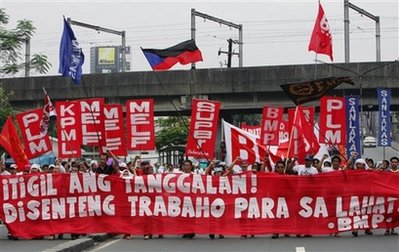
Hundreds of workers and the urban poor belonging to the Bukluran ng Manggagawang Pilipino together with its allied organizations namely; Sanlakas, KPML, SUPER, MELF, ZOTO, PMT and PLM marched down to Mendiola to highlight what they dubbed as their basic demands to P-Noy in his first day of office at Malacanang.

These demands were prominently displayed in their huge streamers which the group believed would open the door to alleviate the misery and poverty of the Filipino people. Addressing the problems of rampant contractualization, demolition and housing, Oil deregulation Law and the Expanded Value Added Tax (EVAT) and the debt moratorium would form as the core issues that the present administration should focus and resolve.

Unfortunately these issues were not profoundly articulated by P-Noy during his earlier campaign for the Presidency and even in his inaugural speech at Quirino Grandstand last June 30. His slogan of “Walang korap, kung walang mahirap” seemed to have died down and now is being regarded very superficially.

Mr. Leody De Guzman, in an interview elaborated that “P-Noy should lead the country to arrest corrupt officials including former PGMA and must be true to his word in fighting poverty and as such, his administration should launch offensives by addressing the very core issues that has became key factors for the marginalization of the Filipino people. This is the very reason why we are knocking at the Malacanang doorstep to present these important demands of the basic sectors.” (30)

Lunes, Mayo 24, 2010

Press Statement - The Thai Crisis is not yet over

Press Statement
May 24, 2010
BMP (Bukluran ng Manggagawang Pilipno)
Partido Lakas ng Masa (PLM)

The Thai Crisis is not yet over

The pronouncement of the Thai government that the crisis is over and that it is now focusing its rebuilding efforts is a superficial move. The casualties produced after a month long turmoil is reminiscent of a country where the basis of dissent is totally remarkable. The players were the poor from the north and northeast of Thailand who protest against the marginalization. The issue goes beyond marginalization but turned into a class war. The crisis is very political in nature and as such requires political solution.

The Thai government must answer the brute force that it employed to the protesters that resulted to the killings of nearly a hundred and wounding over a thousand people. We deplore what the Thai government did after the failed negotiation with the protesters. Undoubtedly, human rights and democracy were the biggest casualties of the conflict.

The Thai government should look into the gross violation of human rights. Being the guilty party, they must be responsible of the horrible military solution applied that only led to chaos and disarray and worst undermined the real essence of civilian supremacy.

Doing a military might solution to resolve the conflict only aggravate the situation. They must root out the very reason of the issue why the people drove this far. There is social injustice that continues to haunt the people of Thailand, a legitimate issue that will never die down for as long as this will not be addressed comprehensively.

Now the Thai government is only taking chances. Rebuilding should mean real upholding of basic human rights, addressing the issue of poverty and marginalization. All forms of government –sponsored violence must be dissolved. The Thai government must concretely review its policies to reach out to those sectors who cry for marginalization, poverty and discrimination.

Similarly this unfortunate incident happened a few years ago in the Philippines where the battle of the poor was also articulated. The EDSA Tres fiasco was regarded an act of rebellion that started with Estrada’s claimed to power but in the end became an issue of class war. No amount of rebuilding can be done to resolve the conflict not unless the government has the political will to go over the issue of marginalization, upholding civil and political rights and adhering the reign of civilian supremacy.

Martes, Mayo 18, 2010

Bukas na liham para sa manggagawa at kababayan sa Pasig

Bukas na liham para sa mga manggagawa at aming kababayan sa Pasig,

Mga kapwa naming manggagawa at kababayang taga Pasig, kami po ay mga manggagawa ng URC sa Rosario at Bagong Ilog na inobliga ng aming management na magpabayad na at tapusin ang aming pagtatrabaho sa kompanya.

Kami po ay 157 lahat, matatagal nang naglilingkod sa URC, mga regular na manggagawa at siyang naging katuwang ng management sa pagpapaunlad ng kanyang kompanya.

Inoobliga kaming magpabayad na dahil redundant na raw ang aming ginagawa o may gumagawa na ng aming trabaho kayat di na kami kailangan.

Ayaw naming magpabayad. Nais pa naming magtrabaho. Nais pa naming tumanggap ng regular na sahod kada akinse at katapusan. Nais pa naming makasama ang aming mga kamanggagawa sa huling mga taon bago ang aming retirement.

Subalit dahil sa pressure ng mga abogado ng management at pang-eengganyo ng Pangulo ng Unyon, marami sa amin ang naobligang magpabayad na. Kami namang ayaw magpabayad ay pinadalhan ng termination paper noong April 23 at pinagtatanggal na rin po kami.

Di po kami nagpapabayad dahil hindi kami naniniwala sa dahilan ng management na redundant na ang aming ginagawa. Dahil kung totoong redundant na, e bakit may pumapalit sa aming pwesto at ipinagpapatuloy ang aming ginagawa?

Hindi rin kami naniniwala sa paliwanag na hindi kami skilled dahil kung totoo ito, hindi kami tatagal ng mahabang panahon sa URC. Isa pa, nahuli namin sa bibig mismo ng abogado ng management nang sabihin niyang “tanggapin na lang namin ang bayad dahil payag naman daw ang management na muli kaming i-hire under AIMKO” (ang labor placement agency cooperative na itinayo ng pangulo ng aming unyon).

Lumalabas hindi po totoo ang dahilan na redundancy, kundi ito ay kontraktwalisasyon! Uubusin ang regular na manggagawa sa URC upang palitan ng contractual. Contractual na minimum lang ang sahod, walang unyon, walang CBA, kapos sa benipisyo at higit sa lahat ay walang karapatan.

Sa ganito nga namang sistema, mas makakatipid at higit na kikita ang management ng URC. Pero bawal po ito! Iligal ang pagtatanggal ng regular para palitan ng contractual. Ito po ay isang anyo ng pagsasamantala sa mga manggagawa kayat ipinagbawal ng batas.

Ito po ang dahilan kung bakit kami ay ayaw magpabayad. Kung bakit kami ay lumalaban. Nais naming ituwid ang baluktot at itama ang mali. Nangangamba kami na kung lahat ay mananahimik at walang lalaban, magpapatuloy ang ilegal na tanggalan ng mga regular na manggagawa upang palitan ng kontraktwal.

Kaya't nagpasya na po kaming lumaban kahit alam naming mahirap. Dahil naniniwala kami na kapag sobra na ay kailangan ng labanan.

Kung bago at maliit pa sanang kompanya ang URC ay madaling unawain, subalit isang dambuhalang negosyo na ang URC. Pang-apat na sa pinakamayamang negosyante sa Pilipinas. Ano pa ba naman ang kailangan niyang patunayan, para kaming mga regular na manggagawa ay pagtatangggalin pa at alisan ng ikabubuhay?

Kaya't hiling namin sa management na ibalik kami sa trabaho. Lingunin naman ang mahabang panahong tapat naming paglilingkod sa URC. Di naman sila nalulugi at patuloy pa ngang kumikita. Hintayin na lang sana ang aming pagreretire.

Hiling naman namin sa inyo mga kababayan at kapwa namin manggagawa ang inyong pag-unawa at suporta sa aming pakikipaglaban.

Itigil ang pagtanggal sa mga regular na manggagawa!

Itigil ang kontraktwalisasyon!

Ibalik ang mga manggagawang tinanggal!

URC 41
Mayo 18, 2010

Martes, Mayo 4, 2010

Bukas na Liham ng Victoria Manufacturing Corporation Workers Union

Bukas na liham para sa aming kapwa manggagawa at kababayan.

Lahat po ng paraan upang maiwasan ang welga ay ginawa na namin. Sinulatan namin ang management , humingi ng pakikipag-usap, lumapit na rin kami sa Department of Labor, Subalit sadyang ayaw pakinggan ng may-ari ang aming kahilingan. Ipinakiki-usap namin na ibalik ang anim na araw naming pasok sa loob ng isang linggo.

Sa ngayon po ay pinagtatrabaho na lang kami ng aming kompanya ng isa (1) hanggang tatlong (3) araw kada isang lingo. Nagsimula po ang ganito naming sitwasyon noong pang nakaraang taon, noon pang bagyong ondoy , nang ilubog ng baha ang aming pabrika.

Inunawa po namin ang kompanya, tinanggap namin sa mahabang panahon ang paminsan minsan na lang na pag pasok sa trabaho dahil nga sa pinsalang dulot ng bagyong Ondoy. Tumulong kami sa pagkukumpuni ng mga makinang nasira at paglilinis ng buong pabrika upang maibalik sa normal na operasyon.

Nagbunga ang aming pagtutulungan, napatakbo ang maraming makina, nagbalikan na ulit ang mga pangunahing customer, sapat na ang gawain sa loob upang mabigyan ng tuloy tulkoy na trabaho ang lahat ng mga manggagawa.

Subalit ang malungkot, ang pumasok na trabaho na dapat kami ang gumagawa ay inilabas ng pabrika at ipinagawa sa iba. Pati ang dating gawaing ginagampanan ng dalawang tao ay pilit na ipinapaako sa isa na lamang manggagawa. Ito po ang dahilan kung bakit hanggang sa ngayon ay 1 hanggang 3 araw pa rin ang pasok kada isang lingo.

Mabigat na po ang ginawa naming pagtitiis sa nakalipas na pitong (7) buwan. Pagtitiis sa 1 hangang 3 araw na sweldo kada linggo. Apektado na po hindi lamang ang pag-aaral ng aming mga anak kundi maging ang kalusugan ng aming pamilya.

Mas lalong bumibigat at gumuguhit ang hapdi sa aming dibdib sa tuwinang makikita naming ang trabahong dapat kami ang gumagawa ay ipapatrabaho sa iba. Ito po ay mali at alam na alam di ng management na ito ay labag sa batas.

Unfair Labor Practice po ang tawag sa pag contract- out ng trabaho. Ito ay ipinagbabawal ng batas paggawa. Hindi ito pwedeng itama nang katwirang masnakakamura sya sa mga kontraktwal na taga labas dahil ito mismo ang dahilan kung bakit ipinagbabawal. Pinahihintulutan lamang ang Contrating –out ng trabaho kung sobra- sobra at di kayang tapusin sa takdang panahon ng kanyang sariling manggagawa.

Dahil po dito, kahit alam naming mahirap, nagpasya po kaming mag Welga, suungin ang napaka- init na panahon sa picket line upang itama ang maling ginagawa ng management at ipaglaban ang aming karapatan at kabuhayan.

Panawagan namin sa aming management na huwag ilabas ang trabahong dapat kami ang gumagawa at ibalik sa anim na araw ang aming pasok!

Hiling naman namin ang inyong pang-unawa at suporta sa aming ipinakikipaglaban.

Mabuhay po kayo at mabuhay ang uring manggagawa.

Victoria Manufacturing Corporation Workers Union.

Martes, Abril 27, 2010

CHR's De Lima on Goldilocks Workers' Strike

COMMISSION ON HUMAN RIGHTS

On the Occasion of the Forum on the Recently Concluded Goldilocks Strike

Bantayog ng mga Bayani Foundation Auditorium, Quezon City
20 April 2010

Keynote Speech delivered by

LEILA M. DE LIMA
Chairperson, Commission on Human Rights of the Philippines

HUMAN RIGHTS PERSPECTIVE
ON THE RIGHT TO WORK


I. The Culture of Impunity

A. Abuses by Government

One of the things that we at the Commission on Human Rights (CHR) continue to condemn is the culture of impunity which prevails in the Philippines. Activists have been abducted and killed, detainees have been tortured, and community members have been coerced, intimidated and injured, and yet in many cases the perpetrators of these abuses have not been caught, prosecuted or convicted.

B. Abuses by Companies

The culture of impunity protects not just violations on the part of government, however, but also abuses carried out or colluded in by private companies and their managers. Employees have been illegally terminated, legitimate unions have been undermined, and companies have blatantly refused to provide their workers with the benefits required by law. Even if these violations are expressly punished in the Labor Code of the Philippines and human rights law, too many firms and employers continue to evade meaningful accountability.

Impunity rewards those who commit violations, and sends the deplorable message that the powerful, the well connected and the wealthy, are able to place themselves above the law. This impunity is appalling and unacceptable, but every once in a while, we witness a situation which demonstrates that even the wealthy can be compelled to adhere to the law, that even the well connected do not always get their way, and that a concerted, sustained and principled effort on the part of employees, can force even the powerful to take heed and change their stance.

Ang kawalan ng pagpataw ng hustisya sa mga taong lumalabag sa mga karapatang pantao, ay nagbibigay ng nakababahalang mensage na ang mga may kapangyarihan, may koneksyon, at may kayamanan, ay hindi napapailalim sa batas. Ang sitwasyong ito ay hindi nararapat at hindi katanggap-tanggap. Subalit kahit na ganito ang madalas na nangyayari, paminsan-minsan may mga pagkakataon na kahit ang mga mayayaman ay napipilitang sumunod sa batas, na hindi lahat ng kagustuhan ng mga may koneksyon ay palaging nasusunod, at sa pamamagitan ng patuloy at sama-samang pakikibaka ng mga empleyado, kahit ang mga makapangyarihan ay napipilitang makinig at magbago.

It is these victories against the culture of impunity which reveal that accountability is still possible in our country, and that impunity is not necessarily the ultimate fate of our nation. The successes which take place validate our efforts, refocus our energies and renew our hope. And the recent positive outcome of the strike against the Goldilocks Bakeshop Inc., is one such example.

II. The Successful Outcome of the Strike Against Goldilocks

Therefore, allow me to take this opportunity to congratulate the Bukluran ng Independenteng Samahan na Itinatag sa Goldilocks–Association of Genuine Labor Organization–Bukluran ng Manggagawang Pilipino, or BISIG-AGLO-BMP.

The courage you demonstrated in the face of hardship and intimidation will embolden other human rights advocates suffering from difficult circumstances. Your commitment to standing up for your rights, in the face of fierce at at times acrimonious resistance from management, will help bolster the collective will of local advocates and diminish doubt, especially during those moments when the human rights landscape appears to be particularly bleak. And the principled manner in which you acted, on the whole, offers a template for future action on behalf of workers and their human rights. For your courage, your commitment and your principled stand, we at the CHR thank you.

Ang tapang na pinakita ng BISIG-AGLO-BMP, sa harap ng hirap at pananakot, ay makakadagdag sa tapang ng ibang mga nakikibaka para sa mga karapatang pantao. Ang patuloy ninyong paninindigan para sa inyong mga karapatan ay makakapagbigay-kumpyansa sa ibang mga tao at organisasyon, lalo na kapag nawawalan na sila ng loob at pagtiwala. At ang malinis na paraan ng inyong paninindigan, habang nagaganap ang negosasyon at ang pagtigil ng trabaho, ay maaaring magsilbing halimbawa sa ibang mga organisasyon at unyon, habang sila rin ay naninindigan para sa kanilang kapakanan. Dahil sa inyong tapang, paninindigan at malinis na pakikibaka, kami sa CHR ay nagpapasalamat sa inyo.

Let me also take this opportunity to thank the other organizations which contributed to this positive outcome, and which continue to advocate for the human rights of workers. Let me thank the Philippine Alliance of Human Rights Advocates, the Urban Missionaries, the Philippine NGO-PO Network on ESC Rights, and all the other individuals and institutions which lent their support to the striking Goldilocks employees, and which exerted pressure on management to adjust its stance.

Human rights advocates often find that a formidable array of interests and resources are brought to bear in order to continue to undermine people’s rights and maintain the status quo. This is why we seek to more closely coordinate our efforts and cooperate with one another. And this is why the CHR continues to extend its support to those persons and organizations who are working to improve the conditions faced by workers and employees.

Before I proceed to discuss some of the lessons which surfaced during the strike against Goldilocks, let me first go through some of the human rights of workers which we seek to protect, which companies must be made to recognize and respect, and which must be further and more fully disseminated to workers and employees.

III. Some of the Human Rights Related to Work

A. Freedom of Association

All persons have the right to freedom of association. People have the right to form and join trade unions, and the right to strike. Therefore, companies must not discriminate against workers because of their union membership. Employers and employees must negotiate in good faith. And management must not prevent union membership, restrict participation by workers in unions, and must ensure that their actions do not undermine legitimate organizations.

Ang lahat ng tao ay may karapatan na mapayapang makipagpulong at magsama. Ang bawat tao ay may karapatang magtatag at sumali sa unyon, upang mapangalagaan ang kanilang kapakanan. Hindi maaaring baguhin ang pagtrato sa isang empleyado dahil lamang siya’y bahagi ng isang unyon. Ang kompanya at ang mga empleyado ay dapat na makipag-usap at makipag-ayos sa paraang malinis at tapat. Hindi maaaring ipagbawal o pahirapan ng kompanya ang pagsanib o pakikilahok sa unyon, at hindi ito maaaring gumawa ng aksyon na nagpapahina dito.

B. Freedom from Discrimination

All persons have the right to live free from discrimination on the basis of such things as race, color, sex, language, religion, political or other opinion, national or social origin, property, birth or other status. Companies must not engage in this type of discrimination when deciding who to recruit, how much to pay, who to train, who to promote, and so on.

C. Freedom of Opinion and Expression

All persons have the right to freedom of opinion and expression. These rights must be respected, and companies must not unfairly persecute employees on the basis of opinions they hold, or the ideas or sentiments that they express.

D. The Right to Just and Favorable Conditions of Work, and an Adequate Standard of Living

All persons have the right to enjoy just and favorable conditions of work. Employees must be paid wages which are fair, and sufficient to enable a decent living for themselves and their families. Workers have the right to adequate food, water, clothing and housing. And employees have the right to healthy and safe conditions at work, as well as adequate rest and leisure.

Ang lahat ng tao’y may karapatang magtrabaho, at ang kanilang trabaho ay dapat na makatarungan at kanais-nais. Ang binabayaran sa mga empleyado ay dapat na makatarungan din, at makakatiyak ng antas ng buhay para sa kanila at sa kanilang pamilya, na nararapat sa karangalan ng isang tao. Sila’y may karapatan sa sapat na pagkain, tubig, pananamit at paninirahan. At ang mga empleyado’y may karapatan sa sapat na pamamahinga at paglibang.

Now, these are only a number of the human rights of workers, which the government must protect and businesses must respect. These rights are not just found in local legislation, but also in international law. These rights are not mere guidelines or suggestions. Instead, these are duties which the government and companies must carry out, or else they will be in breach of their international obligations.

IV. Some of the Lessons Learned from the Strike

I am certain that many lessons were learned over the course of this strike, especially by those who were at the front lines, and who witnessed the changing developments on the ground firsthand. From my perspective, there were certain key strengths and factors which appear to have substantially contributed to the success of the endeavor.

A. Knowledge of the Law

In the documents released to the public by the striking Goldilocks employees, one of the statements made explained that even if the workers themselves are not lawyers, they studied the Labor Code and learned about their human rights. This, I believe is important, because what is clear is that the company and management have the ability to hire lawyers to represent their cause, and some of the officers of the corporation may themselves in fact be lawyers. This access to legal representation favors employers because they know what is found in the law, they know what the Labor Code says, they know their rights, and they have the ability to use the legal process to defend their rights.

Workers, on the other hand, tend to have much more limited access to lawyers and legal representation, because these services are usually quite costly. In the case of the Goldilocks employees, however, they were not content to merely accept that management would have the upper hand in this area. Instead, the employees took action. They educated themselves on the law and their rights, and this had a concrete effect on how they conducted themselves during the strike.

Since the workers had knowledge of the law, they could better ensure that their actions during the strike would not violate the Labor Code and other relevant legislation. If they had ended up violating the law, out of lack of knowledge and inadvertence, then the management would have been able to use this to claim that the workers were engaging in illegal activity. When the workers made sure that their actions were in line with the law, this helped prevent the company from using the provisions of the law against the striking employees.

Dahil inaral ng mga empleyado ang nakasaad sa batas, mas nasigurado nila na ang kanilang mga ginagawa, habang nagaganap ang pagtigil ng trabaho, ay hindi lumalabag dito. Mahalaga ito dahil kung sakaling may nagawang paglabag sa batas ang kahit isang manggagawa, siguradong gagamitin ito ng kumpanya laban sa unyon. Subalit dahil alam ng mga manggagawa kung ano ang bawal at kung ano ang hindi, hindi magamit ng kumapanya ang nilalaman ng batas laban sa kanila.

Also, since the workers knew their rights, they could more strongly and more effectively call on the company to fulfill these rights. Again, human rights are not mere guidelines or suggestions. They are obligations which must be fulfilled, and by being able to identify these obligations of management, the workers were able to use the framework of the law, and especially human rights law, to compel the company to agree to their demands.

Dahil alam ng mga empleyado kung ano ang kanilang mga karapatang pantao, nakatulong ito sa paghiling sa mga nagpapatakbo ng negosyo, na gampanan nila ang kanilang mga tungkulin sa mga manggagawa. Mahalagang alalahanin na ang mga karapatang pantao ay mga obligasyon ng dapat tuparin ng mga nangangasiwa ng kumpanya. Dahil alam ng mga empleyado kung ano ang nilalaman ng mga tungkuling ito ng kumpanya, lalong nagamit ng mga manggagawa ang batas, lalo na ang batas tungkol sa mga karapatang pantao, upang pilitin ang kumpanya na sumang-ayon sa kanilang mga hiling.

Far too often we have seen how the scales are tilted in favor of employers and against employees, in the area of legal knowledge and access to legal mechanisms. This did not happen as much in the case of the Goldilocks employees, because of their hard work and efforts, which is something that should be lauded.

B. Use of the Mainstream Media and New Media

One of the other statements to come out of the striking employees noted that the company has the resources to buy paid ads in major newspapers in order to inform the public regarding their side of the story. As a result, the workers issued appeals, calling on members of the mainstream media to also cover their stories, their allegations, and their version of what truly transpired.

The quality of writing which went into the documents issued by the striking employees was impressive. Labor disputes can be complicated subjects, and it can be difficult to explain the roots of particular disagreements, the reasons to favor one side over the other, the manner in which one party is alleged to have violated the law and human rights, and the other facts which help to explain what is truly going on. Sometimes, the justness of a particular side hinges on certain details or certain nuances, which can be difficult to convey to a wider audience. But the striking workers did a very good job of explaining their side of the story, so that even if their dispute with Goldilocks involved quite a number of issues and a somewhat convoluted timetable, from a reader’s point of view, it was very possible to understand why exactly the workers felt that they had to go on strike.

And the workers did not stop at issuing these statements. They made express requests to the mainstream media to balance the paid advertising done by the management, with coverage of their concerns and experiences. And it appeared to work, given that there have been quite a number of articles in the newspapers, detailing the dispute and providing greater context by citing the statements made by the employees.

So here, the workers could have simply given up upon being confronted by the paid ads of the company, since they did not have the resources to take out an ad in the newspaper themselves. But instead of giving up, they found a way to help level the playing field, by appealing to the sense of justice and fair play of reporters and other media practitioners.

The workers did not stop there, however. Instead, they went beyond the mainstream media and took their statements and their voices into the new media, namely the internet. Through blogs, Facebook and other social media sites, the striking employees were able to take their stories and address them directly to the public at large. And by doing so, they were able to more effectively appeal to the public to take note of their plight, to support their endeavor, to disseminate information regarding the facts of the dispute, and to apply pressure on Goldilocks by boycotting the company’s products, or at least reducing consumption thereof. This use of new media also allowed striking workers to take some small comfort from the fact that out there, there were individuals who now knew about their struggle, and who wished them a successful outcome, so the use of the internet benefited the employees at the personal level as well.

The internet has always held much potential for those of us who advocate on behalf of human rights, because it offers a very inexpensive way of reaching out, not only to the rest of the country, but also to the rest of the world, almost at the speed of thought, in order to disseminate news on the true nature of human rights protection in the Philippines. Such dissemination can be even more potent, where advocates do not merely report developments using text, but accompany it with pictures and video. The strike against Goldilocks offers a concrete example of just how useful and powerful the internet can be, especially when those who avail of it possess fewer resources than those on the other side.

C. The Power of Concerted Effort

Finally, one other lesson which surfaced during the strike is the effectiveness of having the workers ally with other like-minded individuals and organizations, in order to advocate for their rights. It may very well be very difficult for a union, acting on its own, to convince management to agree to its demands. The company may simply choose to ignore the claims of workers, secure in the belief that in the end, the workers will succumb. But when the workers find allies, not only in other unions, but in organizations outside of the traditional labor movement, the number of people supporting the union can reach a critical mass of persons who can no longer be safely ignored by management. When calls for product boycotts become credible because of the number of people involved, and when the press begins to pick up on these stories, again because so many people are disseminating them and informing others regarding the situation on the ground, then the pressure applied on management might end up being enough to compel them to adjust their bargaining positions.

It almost goes without saying that a union allied with other organizations will fare much better than a union operating on its own. The strike against Goldilocks offered eloquent evidence of this, and affirmed the need for those of us who advocate on behalf of the rights of workers, to band together and combine our efforts, so that we can be more effective in bringing about substantial change.

V. Conclusion/Final Words

The positive outcome experienced by the BISIG-AGLO-BMP is an encouraging sign for the effort to protect the rights of workers in the Philippines. This hard-fought victory demonstrates that even with all the vested interests allied against the human rights effort, and even if many individuals continue to work to undermine the rights of labor, the continuing struggle does have the potential to bring about real change.

Ang tagumpay na nakamtan ng BISIG-AGLO-BMP ay isang pangyayaring nagpapasigla sa pagsisikap nating ipagtanggol at pangalagaan ang mga karapatan ng mga empleyado sa Pilipinas. Pinapakita ng tagumpay na ito na kahit na napakarami ng mga gustong humadlang sa adhikain natin, at kahit na maraming nagsisikap upang hindi magampanan ang mga karapatan ng mga empleyado, ang ginagawa nating paninindigan at pakikibaka ay maaari pa ring makaresulta sa tunay na pagbabago.

At habang patuloy kayong naninindigan, patuloy rin ang pagsuporta sa inyong pakikibaka ng Komisyon ng Karapatang Pantao. Salamat po sa inyong lahat.


May 1, 2013 rali

Das Kapital published on 14 Sept 1867

Das Kapital published on 14 Sept 1867

Itigil ang Tanggalan!

Itigil ang Tanggalan!
Disenteng Trabaho para sa Lahat!

kagutuman sa kabila ng kahirapan

kagutuman sa kabila ng kahirapan

Mga tagasunod

Slam Evil, Slam Apec

Slam Evil, Slam Apec
November 1996