Uring Manggagawa, Hukbong Mapagpalaya!

Sosyalismo ang Lunas! Ibagsak ang mapang-api't masibang kapitalistang sistema! Manggagawa sa Lahat ng Bansa, Magkaisa!

Sabado, Disyembre 18, 2010

Pagyamanin ang Kislap ng Pag-asa ng Kilusang Unyon

Pagyamanin ang Kislap ng Pag-asa ng Kilusang Unyon

Nabababanaag natin ngayon ang kislap ng pag-asang iniluwal ng tagumpay ng pakikibaka ng mga manggagawa sa Phil. Airlines, Imarflex, Procraft at Lakeside.

Mga natatanging karanasan na pupukaw ng inspirasyon sa mga manggagawang Pilipino; maihahalintulad sa welga ng mga manggagawa ng LK Guarin at La TondeƱa na bumasag sa pananahimik ng kilusang manggagawa simula ng ipataw ang Martial Law noong 1972. Welgang nagbigay ng buwelo sa kilusang manggagawa upang makabangon at patuloy na sumigla’t lumaganap sa bansa hanggang sa panahon ng revolutionary government ng dating Pang. Cory Aquino. Kinatampukan ito ng pagdadamayan, pagkakapatiran at mga koordinadong pakikibaka ng mga manggagawa mula lokal hanggang sa pambansang saklaw. Tinagurian ng yumaong Blas Ople, Kalihim ng DOLE sa panahon ng Martial Law, ang panahong ito na “masamang interegnum”, may batas subalit di maipatupad ng estado.

Ngunit nang mapagtibay ang Herrera Law noong 1989 na saligan ng Assumption of Jurisdiction (AJ), nanumbalik ang Martial Law sa kilusang manggagawa. Ang pangil ng AJ ay pinatalim ng kamandag ng militarisasyon. Walang habas na inatake ang mga picket line, walang pinipili, maging militante o hindi ang unyon. Hindi nakayanang depensahan ang mga picket line laban sa truncheon at armalite ng mga unipormadong goons. Nauwi sa pagkatalo’t pagkalusaw ng mga unyon ang mga tampok na welga, nagdulot ito ng demoralisasyon at terror-effect sa kilusang manggagawa.

Ang panahong ito ay sinabayan pa ng pagputok ng mga krisis pang-ekonomiya, black propaganda laban sa unyonismo, pagsangkalan ng estado’t mga kapitalista sa globalisasyon, malawakang tanggalan sa trabaho at paglaganap ng kontraktwalisasyon. Ang cumulative impact ng mga ito ay delubyo sa kilusang manggagawa. Halos maglaho ang mga nakamit na tagumpay ng kilusang manggagawa sa nakaraang isang daang taon.

Nalusaw ang maraming unyon, lumaganap ang negatibong pananaw sa unyonismo, lalo na sa hanay ng kabataang manggagawa. Pinakamasahol sa lahat, ang sistematikong pagkakait sa karapatang mag-organisa sa pamamagitan ng labor flexibilization sa anyo ng kontraktwalisasyon at labor-only contracting. Sa pagtatapos ng unang dekada ng bagong milenyo tinatayang bumagsak ng 75% ang bilang ng manggagawang covered ng CBA.

Sa kabila ng ganitong kalagayan, hindi maiiwasang mamulat ang mga manggagawa bunsod ng labis na kaapihan at pagdurusa sa kalupitan ng mga kapitalista, maunawaan ang katumpakan ng makauring pagkakaisa at harapin ang mga hamon ng kasaysayan.

Pinatunayan ito sa laban ng PAL Employees Assn. Hindi sila umatras sa planong magwelga kahit nagdesisyon si DOLE Sec. Baldoz na management prerogative ang pakana ng PAL na outsourcing na mangangahulugan ng retrenchment ng 2,600 empleyado.

Sa isyung ito, humantong ang mga malalaking sentro’t pederasyon sa paggawa sa isang makasaysayang pagkakaisa bilang suporta sa laban ng PALEA, kabilang ang TUCP, FFW, BMP, KMU, APL, PM at iba pa. Di nagtagal ay sinuspinde ang naturang desisyon.

Noong Nobyembre 16, 2010, labindalawa (12)-kataong kasapian ng unyon sa Imarflex Battery (sa Pasig) ay nagwelga upang ipaglaban ang mga makatarungang kahilingan sa CBA, sa kabila ng may mahigit 200 contractual workers ang kompanya. Hindi inalintana ng mga manggagawa ang dehado nilang bilang versus contractual. Magiting nilang dinepensahan ang picket line sa loob ng walong (8) araw hanggang sa mapwersa ang kapitalistang makipagkasundo. Naipagtagumpay ng mga manggagawa ang kanilang mga kahilingan.

Hindi pahuhuli ang laban ng mga manggagawa ng Procraft sa Calauan, gumagawa ng baseball gloves na pang-export. Sa gitna ng CBA negotiation, naramdaman ng mga manggagawa na ang gradual na pagbabawas ng kanilang trabaho ay taktika ng management tungo sa temporary shutdown upang pahinain ang kanilang determinasyon at durugin ang unyon. Dahil dito, taya-batong ipinutok ng unyon ang welga kahit walang Notice of Strike. Paralisado ang kompanya, makalipas ang mahigit isang (1) buwan na welga, nakipagkasundo ang kapitalista. Balik sila sa trabaho ng walang kaso (no retaliatory action), natapos ang CBA at nakamit nila ang matagal ng minimithi --- ang maging daily regular basis ang sweldo mula sa mahigit 10 na taon ng pagiging piece rate.

Sa panig naman ng mga manggagawa sa Lakeside Food & Beverage Corp., kapitbahay ng Yasaki-Torres sa Makiling na gumagawa ng bottled water, isang araw na welga --- solved ang mga isyu.

Mahigit isang taon nang ipinaglalaban ng mga manggagawa ang pagtatayo ng unyon. Sagad hanggang buto ang pagtutol ng kumpanya sa unyon. Ginawa nila ang lahat ng paraan upang hadlangan ang karapatan ng mga manggagawa na mag-unyon at makipag-CBA.

Unang pakana ng management ay ipakansela ang rehistro ng unyon. Sinundan ito ng pagkontra sa Petition for Certification Election (PCE), sa kabila ng may batas na ang kumpanya ay hindi partido sa PCE.

Nang manalo ang apila ng unyon sa PCE at mag-order ang DOLE na ilunsad ang certification election, naghain naman ang kumpanya sa Court of Appeals ng application para ipa-TRO ang CE.

Bigo ang kompanya sa pakanang TRO at naipagwagi ng unyon ang CE.

Hindi pa rin tumigil ang kumpanya, iprinotesta ang resulta ng eleksyon kahit walang balidong batayan. Dismissed ang kanilang protesta.

Nang magsumite ang unyon ng CBA proposal, todo-tanggi ang management na makipag-negotiate. Naghain ang unyon ng Notice of Strike sa batayan ng refusal to bargain; at sa banta ng welga, nakipagkasundo ang management makikipag-negotiate na.

Sa panahon ng CBA negotiation, humirit muli ang management. Disyembre 02, tinanggal sa trabaho ang Pangulo, Bise-Presidente at tatlong Board Members sa katuwirang management prerogative na ipa-outsource ang kanilang trabaho. Ipinasok na sa kanilang ATM card ang separation pay. Malinaw na Bargaining In Bad Faith at Union Busting ang bagong pakana ng kumpanya!

Wala nang ibang opsyon ang unyon kundi maghain ng panibagong Notice of Strike. Minaliit ng kumpanya ang unyon dahil may mga nakahanda na silang contractual at agency employees na pamalit sa mga miyembro ng unyon.

Sa unang concilitiation sa NCMB noong Disyembre 06, walang awtoridad na magdisisyon ang ipinadala ng kompanya, kaalinsabay na naglabas ang kompanya ng tatlong truck ng finished products. Sa taya ng unyon ay delaying tactics ang ginagawa ng management, hindi na nila inantay ang nakatakdang concilitation sa Disyembre 08, determinado nilang ipinutok kinagabihan ang welga. Niresolba nila ang kawalan ng kakulangan sa pondo ng unyon, ginamit nila ang adelantadong separation pay na ibinigay ng kompanya.

Sa diwa ng pagkakapatiran, maagap na dumamay sa picket line ang mga unyong kaanib ng BMP sa pangunguna ng Bigkis ng Manggagawa sa Arcya Glass. Paglabas sa trabaho ng mga miyembro ay diretso sa picket line upang makisalamuha’t magbigay ng suportang pisikal at moral. Ang mga naipit na agency workers sa loob ng planta ay nakiisa rin, lumabas sila matapos ang oras ng trabaho. Nabigo rin ang tangka ng management na magpasok ng pagkain at mga bagong agency workers.

Pagsikat ng araw noong Disyembre 7, nagpatawag ang mismong Director ng NCMB ng concilitation meeting. Minarathon nila ang conciliation hanggang sa CBA negotiation na umabot ng madaling-araw ng Disyembre 08. Plantsado na halos ang lahat ng probisyon sa CBA, humirit pa rin ang bagong abogado ng management na ilagay sa kasunduan ang probisyon na “without prejudice” sa nakapending nitong reklamo ukol sa kanselasyon ng union registration.

Agad na napagtanto ng unyon na mangangahulugan ito na mababalewala ang lahat ng kanilang pagsisikap at sakripisyo sakaling kanselahin ng DOLE ang rehistro ng unyon, tulad ng karanasan ng maraming unyon na sa simpleng teknikal na isyu ay nama-magic ang mga disisyon ng DOLE pabor sa kompanya.

Tinindigan ng mga manggagawa na babalik na lamang sila sa picket line kung hindi iaatras ng management ang probisyon ukol sa “without prejudice”. Sa kalauna’y pumayag na rin ang management at mataas ang moral na itiniklop ng mga manggagawa ang picket line.

Mga kapatid sa paggawa, sa kabila ng ipinagbubunyi natin ang mga nakamit na tagumpay, batid nating hindi dapat magkampante, hindi dapat magbaba ng depensa ang mga unyon. Sapagkat hindi maglulubay ang mga kapitalista sa pagpapahina sa pagkakaisa ng mga manggagawa at pag-atake sa karapatang mag-organisa. Sa tindi ng kompetisyon sa mismong hanay ng kapital, pababaan ng labor cost ang sukatan ng kanilang lakas. Mas mababa ang labor cost, mas competitive sa market, mas malaki ang tubo, mas makakaipon ng surplus capital para lamunin ang mga kakumpetensya sa negosyo. Kapitalistang kumpetisyon na walang ibinubunga kundi krisis gaya ng 2009 Global Financial Crisis.

Samakatuwid, walang tigil ang mga hamon na kakaharapin ng uring manggagawa. Patuloy tayong magpalakas, palawakin ang makauring pagkakaisa at pagkakapatiran, mag-aral at magsanay sa sining ng unyonismo. Huwag nating hayaang nakatiwangwang ang mga kapatid na manggagawang hindi pa organisado, lalo na sa hanay ng higit na nakakaraming contractual at agency workers. Ibandila natin sa kanila ang aral ng mga nakamit na tagumpay at ang pag-asang may kinabukasan sa pagiging organisado.

Hindi tayo titigil hangga’t may manggagawang di-organisado. Ang pagkaka-organisa ng mga manggagawa sa bawat kompanya ang landas tungo sa makapangyarihang pagsusulong ng reporma sa mga depekto ng sistemang pang-ekonomiya at pampulitika sa bansa; kawalan ng sapat na empleyo, mababang pasahod, mataas na presyo ng bilihin at serbisyo, kawalan ng hustisya, katiwalian sa gobyerno, kawalan ng desenteng tahanan sa mga maralita, kawalan ng sapat na serbisyong pampubliko, inefficient na labor code at iba pa.

Ito ang mga hamon na kailangang harapin ng kilusang paggawa upang ihanda ang kinabukasan ng susunod na henerasyon ng mga manggagawang Pilipino--- walang iba kundi ang ating mga anak at apo.

Mabuhay ang Kilusang Manggagawa!

- Bukluran ng Manggagawang Pilipino - Timog Katagalugan (BMP-TK)

Huwebes, Disyembre 2, 2010

Workers Denounced TRO For Sale

PRESS RELEASE
December 2, 2010
Bukluran ng Manggagawang Pilipino (BMP)


WORKERS DENOUNCED TRO FOR SALE


Indignant over the granting of a 72-hour temporary restraining order to a supposed Certification of Election of Goldilocks yesterday, members of Goldilocks Union picketed the office of Judge Amor Reyes of Manila’s Regional Trial Court Branch 21.

The decision was a far-out for the Supreme Court has already ruled out a decision with finality to further resolve the dispute through a Certification of Election.

“The unthinkable resolve to grant a TRO by the lower court is a classic example of a tainted institution that would allow its men in robe to act not on the merits of the case but worst, granting a decision that would jeopardize the already in placed rules of court.” Mr. Joel Lachica, Goldilocks Union President asserted in a message during the picket.

“TRO for Sale is not in consonance with the Aquino administrations’ policy to rid of corrupt officials in all branches of the government. We cannot allow the men in robe to practice the power of money at the expense of the poor and helpless people.” Mr. Lachica further elaborated.

The group has found an ally in all of its battery of lawyers. Not even one lawyer condoned with the decision of Judge Amor Reyes. Most of the lawyers have pointed out that such move would constitute an act of contempt of court and should be dealt with.

“We are now contemplating that if the sala of Judge Amor Reyes will issue a permanent injunction, our group will be pursuing an all out campaign for her permanent disbarment. We believe that our move would set a precedent to put a stop the anomalous conduct of some scrupulous judges using the TRO for sale scheme.” (30)

Miyerkules, Disyembre 1, 2010

PR - Nov30

Press Release
November 30, 2010
Bukluran ng Manggagawang Pilipino (BMP)

MILITANTS ONCE AGAIN URGED SEC BALDOZ TO RESIGN

On the occasion of the 147th birth anniversary of Gat Andres Bonifacio, hundreds of workers allied to the Bukluran ng Manggagawang Pilipino (BMP), Kongreso ng Pagkakaisa ng Maralitang Lungsod (KPML), Sanlakas and Partido Lakas ng Masa (PLM) trooped to the office of the Department of Labor and Employment to once again reiterate their call for the Secretary of Labor to resign. As a symbolic gesture, the group handed down a piece of paper which they attributed as the resignation letter that Secretary Baldoz should have accomplished and submitted to the P-Noy administration. In the letter, reasons for the resignation were stipulated as follows: 1. For executing a decision that is detrimental to the workers’ job security. 2. A decision that is absolutely anti-worker and unconstitutional and hence will affect P-Noy’s crusade and battlecry to serve his “real boss”, the marginalized sector.

“The sacking of 2,600 PAL workers institutionalizes the current trends of rampant contractualization of labor. Even if a company is suffering from heavy losses, employing various forms of contractualization scheme is deemed as illegal according to the labor code.” Ronnie Luna, BMP-Executive Vice President explained during the program held in front of the DOLE Office.

The group further expounded that a Secretary who is supposed to protect labor but in effect only paying lip service and proved to be pro-capitalist should have no place in the labor portfolio.

“We cannot support a Secretary that is insensitive to the plight of the Filipino workers. Her decision will usher more of similar kind in the near future that will only bolster the interest of the capitalists. In so doing condoning such person would only aggravate and push further misery for the Filipino workers.” Leody De Guzman, BMP President articulated in an interview.

The group together with the members of KONTRA (Koalisyon Kontra Kontraktwalisasyon) proceeded to Liwasang Bonifacio where other members of the broad labor also converged for a unity march towards Mendiola. (30)

Martes, Nobyembre 23, 2010

BMP’s Solidarity Message on FIND’s 25th Year Anniversary

BMP’s Solidarity Message on FIND’s 25th Year Anniversary

On the occasion of your 25th year Anniversary, we salute and commend the valiant men and women who founded the FIND (Families of Victims of Involuntary Disappearances).

Truly, you have marked your presence in the human rights community through your various programs and services assisting victims of enforced disappearances and their families. Not to mention your own share and contribution to the over-all development of the human rights movement in the country.

We are deeply proud of your continuous struggle and unwavering commitment to serve the Filipino people. In turn, we will not also falter as one of your partners to the upholding and promotion of human rights.

We firmly believe that our crusade will never fade unless real social justice will reign in this nation. We are still witnessing the cries of the poor particularly the workers and the urban poor. We are still confronted with various human rights violations that continue to haunt the Filipino people.

Our mission and vision is yet to be fulfilled, we must work to build a nation where real abundance, peace and justice will prevail.

We are in unison with you and look forward to see a meaningful celebration where everyone is freed from any harm, where not a single abduction will ever be recorded. If that time comes everyday is a celebration for all of us.

In behalf of the working class community, we once again extend our warmest congratulations and solidarity!

Bukluran ng Manggagawang Pilipino (BMP)-National Executive Committee
November 23, 2010

Sabado, Nobyembre 20, 2010

Resolution at the ICLS Conference on PAL Dispute

November 19, 2010

Resolution Calling on President Benigno Aquino III of the Philippines to Reverse the Ruling of his Department of Labor and Employment (DOLE) Secretary on the Philippine Airlines Labor Dispute

We, the participants of the 6th International Center for Labor Solidarity (ICLS) Conference held on November 18-19, 2010 in Taipei, Taiwan, express our strongest solidarity to our embattled worker brothers and sisters from the Philippine Airlines,

We, workers and union activists coming from Australia, Burma, Japan, Korea, New Zealand, Philippines, Taiwan and Thailand, believe that the recent decision of DOLE Secretary Rosalinda Baldoz to allow Philippine Airlines' management to outsource so-called non-core sections of its business and lay-off 2,600 regular employees would set a dangerous trend for capitalists to replace regular jobs with irregular workers,

We believe that such a decision infringes on workers' and union rights,

We believe that such a decision would spell the death of job security in Philippine Airlines and the whole country,

We, therefore, call on President Benigno Aquino III to reverse this anti-worker and anti-union decision in the interest of upholding workers rights and decent jobs,

Be it resolved,

International Center for Labor Solidarity (ICLS)
Taiwan Conference 2010

Introduced by:
Bukluran ng Manggagawang Pilipino (BMP)
Pagkakaisa ng Manggagawa sa Transportasyon (PMT)
Bagong Kapisanan ng Manggagawa - Philippine National Railways (BKM-PNR)

Huwebes, Nobyembre 18, 2010

polyeto - call for Nov25 and Nov30 mob

Manggagawa Magkaisa!
Labanan ang Kontrakwalisasyon!
Ipaglaban ang Regular na Trabaho!

Ilang taon nang namamayagpag ang kontraktwalisasyon sa paggawa hindi lamang sa Pilipinas kundi maging sa buong mundo. Ang kontraktwalisasyon sa paggawa (irregular work ang tawag sa ibang bansa) ay isang anyo ng labor flexibilization scheme; casualization, outsourcing, spin-off, etc. na ipinapatupad ng mga kapitalista sapul ng mauso ang globalisasyon sa buong kapitalistang mundo.

Delubyo ang inabot ng uring manggagawa ngayong malaganap na ang sistemang ito sa pagnenegosyo at pati ang mga matatagal at matitibay na mga unyon ng manggagawa tulad ng PALEA sa Philippine Airlines ay dinudurog ng iskemang ito ng kontraktwalisasyon sa paggawa. Ang mga kumpanya sa ngayon ay nagmementina na lang ng tinatawag nilang core labor na kadalasan ay 10% hanggang 20 % na lamang ng labor force ng isang pabrika, na kadalasan ay mga skilled na manggagawa tulad ng mekaniko at teknisyan na lamang ang nareregular.

Dati-rati ang mga manggagawa ay dumaraan sa kaswal, nagiging probationary at makalipas ang anim na buwan ay isang regular na empleyado ng isang kumpanya na may seguridad sa trabaho mas lalo na kapag ang kanilang unyon ay nagkakaisa at palaban.

Nang marating ng sistemang kapitalismo ang sobra-sobrang produksyon at umapaw ang palengke sa iba’t ibang klase ng kalakal, nagkaroon din ng sobrang kapital na nakatiwangwang, di kumikita at lulutang-lutang sa ispekulasyon ng pandaigdigang komersyo. Kaya’t nang dumausdos ang tantos ng tubo (rate of profit), ang mga kapitalista ay nagpatupad ng iskema para bumawi at ang nasasakripisyo ay ang seguridad sa trabaho at pagpapatindi ng pagpiga ng lakas paggawa sa anyo ng kontrakwal na paggawa, na walang mga benepisyo at seguridad sa trabaho.

Ang mga benepisyo at pakinabang ng uring manggagawa na ibinunga ng paglaban ng mga ninuno nating manggagawa mahigit sandaang taon na ang lumipas ay binawi at ang natitira ay binabawi pa ng mga kapitalista.

Likas sa sistemang kapital ang pagpiga ng tubo at ang lumilikha ng tubong ito ay ang manggagawa lamang, sa pamamagitan ng kanilang lakas paggawa. Sa panahon ng pagtumal ng negosyo, tulad ngayon na nakakaranas ang buong mundo ng mahabang resesyon o pagtumal ng negosyo, walang ibang paraan ang kapitalista kundi ang patindihin ang pagpiga ng lakas paggawa o kaya naman ay maglunsad sila ng digma para sa dominasyon at pagpapasigla ng pag-andar ng produksyon ng kanilang bansa tulad ng nangyari noong 1930’s great depression na nagluwal ng digmaaang pandaigdig na lumutas sa krisis ng sobrang produksyon ng sistemang kapital.

Ang rehimeng Pinoy ay walang pinag-iba sa mga nakaraang administrasyon sa pagtrato sa manggagawa. Ang kanyang kalihim ng DOLE, si Gng Rosalinda Baldoz, ay pumanig sa kapitalistang bilyunaryong si Lucio Tan nang kanyang desisyunan ang kaso ng PALEA, na “management prerogative “ ang outsourcing at pagtatanggal sa 2,600 regular na manggagawa ng PAL na may CBA na nakasaad na bawal mag-outsource kapalit ng regular na trabaho.

Matagal na itong ginagawa sa mga maliliit at malalaking pabrika at kumpanya. Kalakaran ang mga manpower agency na pinagkukuhanan ng mga kontraktwal na manggagawa. Ang SM ni Henry Sy, ang URC ni Gokongwei, ang mga pabrika sa mga export processing zones at industrial subdivisions, lahat na ng mga kapitalista ay nagpapatupad ng 5 buwan na kontraktwal na trabaho.

Hindi na pinapaabot ng anim na buwan ang manggagawa dahil maaring maging regular. At sa ganito ay maiiwasan nila ang pagbibigay ng benepisyo na tinatanggap ng isang regular na manggagawa. Malaki nga naman ang matitipid nila. Ang mga manggagawa naman, pagdating ng “endo” ay hanap uli ng panibagong mapapasukan, mag-aayos na naman ng mga requirements at panibagong gastos tulad ng NBI, police clearance, medical, etc. na lalong nagpapahirap sa buhay bilang manggagawa.

Ang ganitong kalakaran sa paggawa ay lilikha ng henerasyon ng mga kontraktwal na manggagawa. Isang henerasyon ng mga manggawang walang kasiguruhan sa trabaho at walang mga benepisyo na dapat lamang makamit ng isang manggagawang bumilang ng taon sa pagpapaalipin kapalit ng kakarampot na sahod.

Ano ang maasahan ng uring manggagawa sa rehimeng P-Noy? Aasahan nating mga manggagawa ang pagkampi ni P-Noy sa mga iilang kapitalistang lokal at dayuhan kaysa sa milyon-milyong manggagawa na siyang lumilikha ng yaman ng bansa at bumubuhay sa lipunan.

Dahil sa walang maasahan ang uring manggagawa sa gubyernong P-Noy, dapat lamang na magkaisa at kumilos ang uring manggagawa para sa kanyang kinabukasan. Ang ating kapalaran ay nasa ating pagkilos. Ang paglaya ng manggagawa ay nakasalalay sa ating mga kamay.

Manggagawa magkaisa! Labanan ang kontraktwalisasyon!
House Bill 3402 On Security Of Tenure (SOT) Isabatas!
Makibaka para sa Regular na Trabaho para sa Manggagawa!

Panawagan: (Dumalo at Magpadalo)
1. November 25, 3:00pm (Big Rally) sa Ayala, Makati
2. November 30, 8:00am (Full Mobilization) sa Mehan Garden, Manila

Bukluran ng Manggagawang Pilipino (BMP)
SUPER- MELF- PMT- KPML

Miyerkules, Nobyembre 17, 2010

BMP Statement - ICLS 2010 Taiwan Forum Theme

BMP Statement
On the ICLS 2010 Taiwan Forum Theme

I-justify nang BuoDismantling Neoliberalism, Ending Capitalism

Workers of the world are now living in interesting times. The economic thinking that has prevailed in the last three decades, what we now call as neoliberalism, is thoroughly being challenged with its failure to prevent or even predict the 2008 global economic crisis, starting from the problems of finance capital, the drop in demand, the destruction of industries, and increasing poverty in the South.

Why is this interesting for workers? To begin with, this is an economic thinking that has been formulated primarily as an assault of labor to capital. When neoliberalism started in the 1980s capital was experiencing what was then assumed to be a productivity problem. In the United States where it all started, corporations’ profits are thought to be declining, budget deficits are ballooning due to erosion of revenues, and inflation seems to be uncontrollable. In the developing world, so-called “inefficient” governments are also experiencing huge budget deficits, leading to debt problems such as those experienced by Latin America and Asian countries. Globally, capital health is declining.

Who did capital blame? They blamed the workers. They blamed the workers for having too high salaries, too many benefits and wage extenders, and bleeding the government coffers too much because of social security and protection. Understanding this is the key to knowing why neoliberalism, as implemented in the past three decades, had been inherently anti-labor.

We have to understand that before 1980s, workers of the world are benefitting from the concessions they gained from capital, with the state disciplining the market and distributing a portion of the gains from growth. It may be too little, but there are concessions. In the United States, strong labor unions pushed President Franklin Delano Roosevelt to enact pro-labor provisions of the “New Deal”, which contributed to Roosevelt’s popularity. In fact, the recruitment line became: “The President wants you to join a union.” This peaked during Lyndon John’s “Great Society” which brought to the US universal healthcare, home guarantee, and a strong social security. Looking fast-forward to Obama’s time, this is what the neoliberal in America had successfully dismantled, and the people are demanding it back.

In Europe, we have seen the rise of “welfare states” and “full employment” policy, created by social democratic parties who thought they can permanently reconcile the interest of labor and capital. Now experiencing financial crisis and fiscal crisis due to ballooning budget deficits – the worst hit of them being Greece – right-wing Europe is now returning to the power, with some anti-immigration, pro-nationalization parties reminiscent of that fascist Italy and Nazi Germany winning the elections.

In the developing world, the situation is a bit more complicated. For countries such as South Korea, Taiwan, Thailand, Singapore, and Malaysia, strong leadership was able to discipline capital from engaging in unproductive ventures and use its gains to reduce poverty and raise wages. We have seen the rise of state-owned public goods – public railways, public transportation, public utilities which kept services accessible to the public and helped the country become more friendly for development. Thus, some of them actually climbed from “Southern” status to “North”, like South Korea and Singapore. Now, pressured as they are by global capital, the governments of the developing world are now dismantling public ownership, says that the move is more necessary so the countries will be more “competitive”. We see Japan privatizing major banks and postal services, South Korea its railways, and we are yet to see the worst for Malaysia and Thailand.

Some countries in the developing world, for example failed to take-off in period of strong state. In the Philippines and Indonesia for example, dictators Marcos and Suharto ushered a period of kleptocratic states, condemning their countries to low-growth path for the years to come. In Latin America, the economic disasters left by Carlos Menem in Argentina and Fernando Henrique Cardoso in Brazil will be very hard to reverse, although they have strong labor pro-leadership under Kirchner in Argentina and PT in Brazil.

In the world over, capital is saying the same thing, the strong interventionist state of the 1940s to 1970s is keeping the market from achieving its so-called “optimal state”, and strong labor which is extracting concessions from capital is driving productivity down. This pronouncement started what came to be the neoliberal attack to labor. Started by Margaret Thatcher in the United Kingdom and Ronald Reagan in the US, “privatization”, “deregulation”, “liberalization” in a period of “globalization” have been the buzzwords of the 80s and the 90s. This means releasing the state chokehold over the market, and chaining labor again to absolute control of capital. In a span of a decade, state-ownership of utilities and basic social protection have been dismantled in favor of privatization, “Build-Operate-Transfer” projects, Health Maintenance Organizations, joint venture of governments with corporations, among others.

Labor clearly suffered. Minimum wages have been abolished in favor of “competitive” and “market-set” wages. Pensions have been cut, mandatory retirement age has been raised, and social security has been reduced. Flexi-labor has been started, and labor unions which refused saw their jobs being outsourced offshore or contracted in China or India. Government kept wages down by increasing unemployment – forcing workers to be satisfied with decreasing salary by surrounding them with unemployed citizens. “At least I have a job” is now the new mantra. Developing countries are worse off. Labor there are not just repressed, they are thoroughly oppressed through contractualization, lack of tenure, inhumane living and working conditions, and state violence directed to union leaders.

As has been said by many people, systems, including neoliberalism, breed its own death. What has been the cause of neoliberalism’s decline? The so-called “wage repression” decreased effective demand – the demand over goods and services sold in the market. We have to put this in a context. During the 1940s, the central problem of capitalism was how to create demand. Goods are not being sold, in fact, they are being destroyed. Export markets are already saturated. The capitalist solution is increase demand by increasing labor income. And because of strong pressure from the unions, capital has no other choice but to do so. Government increased spending, government enacted wage standard. And thus the era from 1940s to 1970s.

With neoliberalism, demand decreased. How can you buy more when you have less to spend? In the developing world, this meant increase in absolute poverty. And with the government now reduced by neoliberalism to merely “regulation”, it is disempowered to resolve this problem. In the developed countries, the solution to decreased demand has been to increase credit. You can’t buy it? Use your credit card. You can’t own your home? Here is subprime loan. We know that debt is unsustainable if not coupled by rising income, and we see the whole house tumbling down during 2008 US financial crisis – the start of a worldwide capitalist crisis spreading to Greece, China, and even Latin America.

Neoliberals and the capitalists who believe them are now discredited. We see this in the Philippines by the repudiation of Arroyo who gained the reputation as the most debt and privatization-dependent President. We see this in US with a white population voting an African-American to power with the promise of change, which turned out to be false, but that is another matter. We see this with the G8, the club of rich countries, threatened by global pressure, quickly convening the G20 just to save themselves. There are many more examples.

At this point, workers of the world have two choices. Either we go back to merely capital control and labor concessions, which of course will lead to better labor welfare but will nonetheless bring about again the conditions that brought neoliberalism, or abolish capitalism altogether. Either we turn back the time a bit to better times, or make things permanently better by ushering a new system. Either we end neoliberalism only, or end capitalism itself.

And it is not as if there are no inspirations for us. Venezuela, for example, gaining victories from US-backed Venezuelan elite, is on a transitional process towards what it calls as “21st century socialism”. Brazil is now lead by woman ex-guerilla Dilma Roussef. The rest of Latin America is now catching the epidemic of anti-capitalism. Nepal voted left-wing candidates into power. The left also gained grounds in Japan with the defeat of the long-standing LDP, and in Thailand with the recent Bangkok siege.

The lesson here, as it had been the lesson in the 1940s and 1970s, is that labor must be organized not just as a company union or industry power. It must become a political power. Labor must be organized not just to obtain collective bargaining agreements, which is in fact good, but not enough. Labor must not just act to obtain industry-wide wage standards, or even increases in minimum wage. Labor must be organized and capacitated for the eventual seizure of state power. This has been the important lesson that Vladimir Lenin, then fighting against a Russian monarchy, had taught us workers. In the end, workers have nothing to lose but their chains. We must overthrow capitalism and not just end neoliberalism.

But of course, in the tactical period to come, we have to expect an intensification of the neoliberal project, so we should not be complacent. While on its death bed, neoliberalism must still be defeated by labor so we can effectively prop-up an alternative to capitalism. We have to frustrate capital’s move to privatize public utilities, railways, social security, water, and healthcare. We have to build people’s confidence on the capacity of labor to govern by leading them in struggles of the “here and now”. Neoliberalism will not die by itself; labor must dismantle it. Doing so will put labor in a position of strength as it dismantles capitalism itself.

And to quote from a Marxist thinker and Italian revolutionary Antonio Gramsci, he said, that “the challenge of modernity is to live without illusions and without becoming disillusioned.” Workers of the world should not have an illusion that ending capitalism will be easy, but it should also not think that it will be here forever.

Published at the ICLS blog http://icls.or.kr/bbs/view.php?id=en_reports&page=1&sn1=&divpage=1&sn=off&ss=on&sc=on&select_arrange=headnum&desc=asc&no=195


May 1, 2013 rali

Das Kapital published on 14 Sept 1867

Das Kapital published on 14 Sept 1867

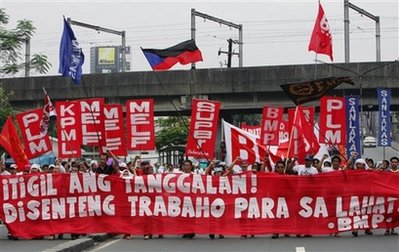
Itigil ang Tanggalan!

Itigil ang Tanggalan!
Disenteng Trabaho para sa Lahat!

kagutuman sa kabila ng kahirapan

kagutuman sa kabila ng kahirapan

Mga tagasunod

Slam Evil, Slam Apec

Slam Evil, Slam Apec
November 1996