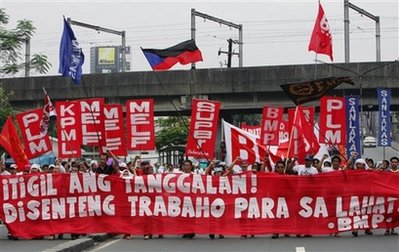
Uring Manggagawa, Hukbong Mapagpalaya!

Sosyalismo ang Lunas! Ibagsak ang mapang-api't masibang kapitalistang sistema! Manggagawa sa Lahat ng Bansa, Magkaisa!

Sabado, Oktubre 22, 2011

polyeto - Occupy Wall Street, Occupy Ayala - Oktubre 21, 2011

Nilalaman ng polyetong ipinamahagi sa isinagawang pagkilos sa Ayala, Makati, Oktubre 21, 2011.

PAGKAGANID SA TUBO: PAHIRAP SA MASANG PINOY

Nakikiisa kami sa pandaigdigang panawagan laban sa pagkaganid sa tubo at emperyo ng kapitalismo. Itinuturing namin ang "Occupy Wall Street" bilang inspirasyon sa mundong pinaagas ng mga pandaigdigang monopolyong korporasyon.

Doon sa puso ng kaaway - sa pinakamalaking kapitalistang ekonomya ng mundo - sumisigaw, kumikilos ang mga manggagawang Amerikano sa iba't ibang syudad laban sa pinakamalaking agwat ng mayaman at mahirap sa mahabang kasaysayan ng sistemang kapitalismo sa daigdig.

Ang "Occupy Wall Street" ay naghawan ng bagong daan na nagpadaluyong ng protesta sa buong mundo laban sa bulok na sistemang kapitalismo na ugat ng kahirapan ng sangkatauhan. Sa maraming bansa, inokupa ng mga nagpoprotesta ang mga plaza upang ipakita ang kanilang matinding galit sa pagkaganid ng mga korporasyong kapitalista.

Tayong mamamayang Pilipino ay matagal na ring biktima ng pagkaganid sa tubo ng mga kapitalista, kaya nagpoprotesta kami dito sa Philippine stock Exchange na simbolo ng walang hanggang pagkauhaw sa tubo.

Ngunit higit na mahalaga ang nilalaman kaysa porma, lumalahok kami sa pandaigdigang panawagang "Mamamayan muna bago tubo." Kaya, dapat unahin ng gubyerno ang kapakanan ng mamamayan kaysa pagkamal ng tubo ng iilang mayaman na.

Nananawagan kami sa Gubyernong Aquino - sa ngalan ng katarungang panlipunan - na baliktarin ang sumusunod na tunguhin, na pawang salaminan kung paanong ang pagkaganid sa tubo ay nagpapahirap sa mamamayang Pilipino:

1. No to Outsourcing and Contractualization! Humingi ng paumanhin sa publiko ang Pangulo sa pagbabanta niyang kasuhan ang PALEA ng “economic sabotage.” Magdeklara ng polisiya na protektahan ang karapatan sa regular at tiyak na trabaho laban sa abusadong paggamit sa “management prerogative” gaya ng outsourcing at downsizing.

2. No to Oil Deregulation! Repasuhin ang mga polisiya kung paano ibabalik ang pagkontrol sa presyuhan ng langis. Sapat na ang labintatlong taong ebidensya para patunayang kung walang kontrol ang gubyerno, walang depensa ang mamamayan sa napakatakaw na pagkamal ng tubo ng mga kapitalista sa langis.

3. In-city Development! Makatao at sustenableng kondisyon (hindi mataas na presyo para sa mga kapitalista sa real estate) ang dapat na pagsimulan ng anumang usapan at resolusyon sa problema ng maralitang lungsod.

4. No to Privatization! Ang pagbebenta ng gubyerno sa pribado (lokal at dayuhang kapitalista) ng mga batayang serbisyong panlipunan gaya ng kuryente, tubig at kalsada ay nagbunga ng sobrang taas na presyo. Di dapat talikuran ng gubyerno ang tungkulin nito sa mamamayan na maglaan ng sapat na pondo, maalam na tauhan, at episyenteng pangangasiwa para sa serbisyong panlipunan. Itigil ang pribatisasyon; huwag pagkaitan ang mamamayan ng serbisyong panlipunan.

5. No to Liberalization! Di dapat iasa ang ekonomikong pag-unlad sa dayuhang puhunan gaya ng dayuhang monopolyo kapital at produkto ng mga dayuhan. Paunlarin ang ekonomya sa pamamagitan ng industriyalisasyon at modernisasyon ng agrikultura.

6. Climate Justice Now! Ang pagkaganid sa tubo ng kapitalismo ay di lamang nagkakait ng trabaho at sapat na kita sa mamamayan kundi banta o panganib rin ito sa ating kinabukasan. Ang mundo ay para sa lahat. Itaguyod ang sustenable at planadong paggamit ng likas-yaman.

SANLAKAS
Bukluran ng Manggagawang Pilipino (BMP)
Pagkakaisa ng Manggagawa sa Transportasyon (PMT)
Kongreso ng Pagkakaisa ng Maralitang Lungsod (KPML)
Aniban ng Manggagawa sa Agrikultura (AMA)
Partido Lakas ng Masa (PLM)
Kalayaan!
Makabayan Pilipinas
SM-ZOTO

Unified Press Statement - Occupy Ayala mob

UNIFIED PRESS STATEMENT
October 21, 2011

SANLAKAS
Bukluran ng Manggagawang Pilipino (BMP)
Pagkakaisa ng Manggagawa sa Transportasyon (PMT)
Kongreso ng Pagkakaisa ng Maralitang Lungsod (KPML)
Samahan ng mga Mamamayan-Zone One Tondo Organization (SM-ZOTO)
Aniban ng Manggagawa sa Agrikultura (AMA)
Partido Lakas ng Masa (PLM)
KALAYAAN
Makabayan-Pilipinas

Corporate Greed: Wrecking havoc on the Filipino People

Our organizations join the worldwide call against “corporate greed” and the empire of capitalism. We look up to “Occupy Wall Street” (OWS) as a beacon to a world bled dry by global monopoly corporations.

Right at the very heart of the enemy – at the biggest capitalist economy – American workers have spontaneously begun to speak out against the widest rich-poor divide in the history of capitalism; not with their voices but with their feet by occupying selected choke points in several key cities in the US.

OWS is a trailblazer that set a wave of anti-capitalist protests around the world. In various countries, protesters have occupied public spaces to express their sentiment against corporate greed.

Because we are inspired by the resurgence in America, we are staging a protest here at the Philippine Stock Exchange - right before the institution which symbolizes capital’s naked and insatiable drive for profit.

But more important than the form is the substance, we are joining the global call for “People before Profit”. Indeed, government must heed the primacy of people’s welfare over the right to profit by the elite few.

We are calling on the Aquino administration – in the name of social justice – to reverse the following trends, which are all manifestations of how corporate greed is wrecking havoc on the Filipino people:

a) No to Outsourcing! The President must issue a public apology for threatening to sue PALEA with “economic sabotage”. Declare a policy of protecting the right to regular and secure jobs against abusive practices of management prerogative such as outsourcing and downsizing.

b) No to Oil Deregulation! Review policies on how to revert back to a regulated oil market. Thirteen years of deregulation is enough evidence to prove that without state intervention, the public would be defenseless against shameless profiteering by the oil oligarchs.

c) In-city Development! Humane and sustainable conditions (not higher land values for real estate moguls) should be the starting point of any resolution to the urban poor question.

d) No to Privatization! The sale of basic public social services (i.e., electricity, water, roads) to the private sector (local and foreign) has resulted in exorbitant prices. Government should not turn its back on its role to provide its people social goods and services. End privatization schemes; do not deny the people of social services.

e) No to Liberalization! Economic development should not be dependent on foreign investment (i.e., foreign monopoly capital) much less foreign products. Develop the national economy through industrialization and modernization of agriculture.

f) Climate Justice Now! Capitalism’s greed does not only deny jobs and income to the people but also threatens our future. The world is for everyone. Uphold sustainable and planned utilization of natural resources.

Biyernes, Oktubre 14, 2011

BMP speech at ICLS - South Korea

The Crisis of Capitalism and the Philippines’ Struggle for Socialism

(Speech of Leody de Guzman, President of the Bukluran ng Manggagawang Pilipino, at the International Center for Labor Solidarity, Seoul, South Korea, October 13, 2011)

Just a few months after it seemed that the dust finally settled after the capitalist crisis of 2008 and 2009, two new crises erupted. There are now talks about a double-dip recession following the Debt Ceiling crisis in the United States and the continuing debt markets crisis saga in the European Union. Both hit the most powerful capitalist economies in the world, threatening to undo market integration projects for which capitalist governments have invested time and money during the apex of the globalization movement in the 1990s. This is more than anything capitalism has faced in almost a century.

At this point in time, it is clear that what we are facing is no longer a short-run, periodic crisis, but rather a deeper crisis in economic management. There were outlooks on a “new normal growth” for the United States – a projected lower growth rate range for the next decade or so for the epicentre of the current crisis. We are now transitioning from a simple financial crisis to a general productivity problem for world capitalism. This only shows one thing – that the global capitalist system is clearly showing its inability to govern the economic affairs of humanity in the most efficient way possible. Global capitalism has lost its edge, its productivity and effectiveness is deteriorating. Clearly, the time has come for something else – a new social and political system – to replace capitalism as a system of production and ownership. Clearly, the time has come for socialism.

Filipino socialists and progressive democrats have seen these developments and have struggled to frustrate capital's attempt to reinvigorate itself, starting from within the borders of the Philippines – a country that has felt the wrath of the global financial and economic crisis. Admittedly, the struggle is difficult, as socialism in the Philippines is currently facing a great threat from a popular champion of the pro-American bourgeois class - President Benigno Aquino III. Aquino, being the son of a slain anti-dictatorship politician Benigno Aquino Jr. and the first post-dictatorship President Corazon Aquino, vowed to continue his parent’s legacy of "clean and honest government" and rid the government of corruption – seen as the biggest threat to the Philippine business class as well as foreign investors. With the Philippines just coming out from the corrupt and illegitimate presidency of Gloria Macapagal-Arroyo, the masses who had been impoverished in the last decade of Arroyo are still willing to give Aquino a chance despite his clearly anti-people, pro-business policy.

Aquino is a great threat to the movement, and this is because he is a powerful deodorant for the stinking Philippine elite. Philippine capitalism needed stability, and the Aquino administration, with its focus on "good governance", "transparency", and "accountability", was designed to provide it. Aquino is necessary for more efficient capital accumulation and exploitation of the working class. This can be clearly gleaned from his Philippine Development Plan (PDP) for 2011-2016 – the Philippine’s economic blueprint for Aquino's entire term – which is essentially neoliberal and supportive of the corporate sector. It promotes Public-Private Partnerships (PPP) as its primary strategy for development – a mode of financing and project implementation designed by the Asian Development Bank (ADB) to facilitate governments’ transfer to corporations its role in public infrastructure and social and economic services. The plan promotes “inclusive growth” – a concept created by the World Bank (WB) which is just a rehash of the debunked “trickle down” approach which recommends “supply-side” support for the rich because it will “trickle down” to the poor. The plan promotes liberalization of mining, which will allow foreign mega-corporations to exploit our natural resources, ruin our ecosystems, and drive out indigenous people from their ancestral domains for profit.

Filipino socialists wasted no time attacking Aquino’s neoliberal blueprint. Partido Lakas ng Masa (PLM) [Party of the Labouring Masses] led a series of attacks against the Philippine Development Plan. Together with broad democratic group Sanlakas, members of PLM marched during Aquino’s 2nd State of the Nation Address (SONA) to condemn what it dubbed as “People’s Destruction Plan”. Other progressive groups such as the Freedom from Debt Coalition (FDC) questioned the “private property regime” that remains to be the basis of the blueprint, forcing the National Economic Development Authority (NEDA) – the cabinet office of neoliberal technocrats – to defend what they called as a “purely competitive economic system” operating under conditions of “profit maximization”. At this point, there is no doubt at which side the Aquino government is on.

Aquino’s pro-capitalist orientation is more obvious in his policies on Philippine labor. The Philippine Employment and Labor Plan (PLEP) outlines plans for labor flexibility as a means to generate “mass employment”. Bukluran ng Manggagawang Pilipino (BMP) attacked PLEP, calling it a “pillar of globalization”. But nowhere is the class character of the Aquino administration more exposed than in contractualization fiasco in the Philippine Airlines (PAL) – the country’s privatized flag carrier now owned by tycoon Lucio Tan, the 2nd richest man in the Philippines.

Lucio Tan, far from being just rich, is the head of a corporate conglomerate that includes the largest tobacco manufacturing firm in the country, rum processing factories, a university, the 5th largest bank in the country, among many other smaller businesses. As of the time of writing, Lucio Tan is set to terminate at the end of September 2,600 ground staff and catering employees in an illegal third-party outsourcing plan. The Philippine Airlines Employees Association (PALEA) conducted a series of protest actions, leading to a sit-down strike last September 27, paralyzing flight operations at Manila airport and costing PAL 80 percent of its daily revenues between $4 million and $5 million. This prompted Aquino himself to threaten PALEA with “economic sabotage” charges – a clear position against Filipino workers who voted him to office. Aquino’s pro-contractualization and pro-capitalist pronouncements in the PAL stand-off speaks louder than his PDP or PLEP.

At the entire course of the struggle, BMP has struggled with PALEA to end contractualization and labor flexibilization in the Philippines. BMP, as a socialist labor center, believes that the struggle against contractualization is a struggle against capitalism itself – which is in a continuing drive to remove all fetters in labor hiring and firing and pull labor wages down. In the Philippines as in the world, this has been a great scourge for the working class, which has struggled to maintain regular jobs and mandated benefits amid drive to increase “competitiveness” in the workplace, which simply means lower wages and higher profits for businesses.

What will they do with workers who eventually be driven to poverty due to widespread “wage repression” and unemployment? Capitalism has an even more sinister solution, and this is clear in the context of the Philippines. Even as it exploits the Filipino working class, the Aquino administration knows that it has to maintain a "human face" to mask the intensifying exploitation under his government – something which it learned from the experiences of other neoliberal governments. This was done in the form of social safety nets, like the controversial Conditional Cash Transfer (CCT) programs that has been criticized by several groups as a "doleout" mechanism. Copied from a progressive measure coming from PT’s Bolsa Familia Scheme in Brazil, which is truly a social reform measure, Philippine’s version of CCT only involves handing out a little more than $30 a month to about 2.3 million families, a scandalously low support to think that the Philippine social welfare department declared it as the “backbone of a modern social protection system”. This just shows how an originally progressive program can be mutated by a capitalist government and used for its purposes.

Urban poor movements such as the Kongreso ng Pagkakaisa ng mga Maralita ng Lunsod (KPML) has thus been at the forefront of the struggle against CCT. Raising the fact that CCT was in fact, financed by a loan from ADB – it insists that CCT only involves transferring money from the future poor to the present poor – since the future poor will have to pay for it through debt service. KPML called CCT as “giving alms to the poor” and a “bandaid solution” that does not address the real problem, which is rising prices and lower wages.

At all fronts – from the ideological to concrete battles – Filipino socialists struggle to win gains versus capitalism: smearing black patches in the face of a defunct system while building the patches of green for a new, pro-people, pro-worker system. In this struggle, our agency for organization, the trade union, has been indispensable even as it is under attack by capitalism. In the Philippines as in the world, innovative means to dismantle unions such as contractualization, labor flexibilization, outsourcing and newly invented employer-employee relations have been deployed by capitalists in full force, but they have failed to erase the concept of unionism and solidarity. Clearly, union as a form of labor unity and expression of dissent remains to be relevant.

But we cannot be complacent. We have to reinvent the union as an organization. We should not be limited to unions at the firm level as our sole form of organizing the working class. We should explore intra- and inter-industry federations, unions of displaced workers, and other innovative organizational schemes. If capitalists can innovate means to disorganize labor, the working class should also have tricks on its sleeve to unify the workers as well as the middle class in the fight for progress.

Aside from innovation in labor organizing, we must not forget a cardinal rule. As the experience of all socialist nations today, the eventual victory for the working class has been preceded by the transformation of the union from an economic to a political organization. Unions, or any other organizational expressions of organize labor, should attempt and succeed at seizing political power. This is what Russia and Latin America did. This is what Filipino workers are now emulating, positioning PLM as a political party that can serve as a focal point of political pressure – just as a magnifying glass would concentrate countless number of sunrays into a one potent laser beam.

History is now on the side of the workers. But a capitalist crisis alone will not usher the age of socialism. The resurgence of fascist forces in the United States in the form of the Republican Party and its Tea Party movement, and in Norway in the person of Anders Behring Breivik – the right-wing who bombed government buildings and perpetrated a mass shooting at a camp of the Workers' Youth League (AUF) of the Labour Party – is enough to warn us that our victory is far from inevitable. But if the emergence of right-wingers like Breivik and the Republican Party or capitalist deodorants such as Barack Obama or Benigno Aquino has anything to teach us, it is this:

Society has to choose now – capital or labor, barbarism or socialism.

Miyerkules, Oktubre 12, 2011

P-Noy at Korte Suprema, Nasa Bulsa ni Lucio Tan

P-NOY AT KORTE SUPREMA, NASA BULSA NI LUCIO TAN

Si Lucio Tan ay ikalawa sa pinakamayaman sa bansa. Nagkakahalaga ng 2.1 bilyong dolyar ang kanyang pag-aari. Siya ang El Kapitan ng iba't ibang mga kumpanya - kasama ang Fortune Tobacco, Asia Brewery, Allied Bank, Philippine Airlines, atbp.

Sa ngayon, humaharap si Lucio Tan sa dalawang kasong hinain ng kanyang mga manggagawa. Sa mga kasong ito, agad na kumampi sa kanya ang Malakanyang at ang Korte Suprema.

Ang unang kaso ay mula sa 2,600 empleyado ng Philippine Airlines, na tinanggal sa kompanya dahil ayaw nilang maging kontraktwal sa ilalim ng mga service provider. Tinututulan nila ang outsourcing - isang iskemang iligal at sumisikil sa karapatang security of tenure.

Kasalukuyang nasa Court of Appeals ang kaso. Pero bago ito humantong sa Korte, si Lucio ay pinaboran ng DOLE at ng Malakanyang.

Mismong si P-Noy ay nagdeklarang kakasuhan daw ng mga abogado ng Palasyo ang mga manggagawa. Economic sabotage daw ang nangyaring pagkakansela ng mga flight ng PAL. Pero ano ba ang ginawa ng unyon (PALEA)? Sila ay nagprotesta sa pagkakatanggal sa trabaho. Bakit nakansela ang mga flight? Dahil sa ginawang pagtatanggal ng PAL management! Sino ngayon ang nananabotahe?

Ang ikalawang kaso ay ukol sa retrenchment ng 1,400 myembro ng Flight Attendants and Stewards Association of the Philippines (FASAP). Nanalo na ang mga manggagawa sa kasong ito. Umabot na sa ikalawang dibisyon ng Korte suprema - matapos ang 13 taon na mahabang proseso ng talo't panalo - ng apela at kontra-apela mula pa sa "mababang korte" (National labor Relations Commission o NLRC).

Sa desisyon ng 2nd division ng Korte, umabot na sa ikatlong Motion for Reconsideration. Kahit pa noong desisyunan ang kaso - pabor sa FASAP - sinabi nitong ang desisyon ay "final and executory". Pinal na at hindi na papakinggan pa ang anumang apela dito.

Pero sa isang iglap, kahit tatlong beses nang paboran ng Korte, muling nabuksan ang kaso matapos lamang silang sulatan ng abogado ng PAL (si Estelito Mendoza ng counsel ni Erap sa impeachment case). Kaya ngayon, nakabinbin muli ang kaso sa buong mahistrado (Supreme Court en banc).

Bakit ganito kalakas si Lucio Tan sa Korte Suprema? Hindi ba't ang hustisya ay may piring sa mata upang hindi siya "masilaw sa yaman" ng nagkakaso o kinakasuhan? At hindi ba't ayon mismo kay Erap, si Lucio Tan ang nagpasok kay dating Chief Justice Davide sa Korte?

Natutukso tayong magduda. Tila sumusunod ang Korte sa ginawang "kontra-manggagawang" tindig ni P-Noy sa kaso ng PALEA. At ang alitan ng Korte at Palasyo ay hanggang salita lamang dahil kapag sinukat sa "gawa", pareho silang umaayon sa kagustuhan ni Lucio Tan.

At hindi natin maiwasang maghinala sa kaso ng FASAP. Ang ligal na obligasyon ni Lucio Tan (full back wages matapos ang reinstatement) sa kanyang mga empleyado ay umaabot ng 3 bilyong piso! Barya lamang ito sa bilyon-bilyong dolyar niyang ari-arian.

Pero imbes na bayaran ang mga myembro ng FASAP, mas mainam pa rin kay Lucio kung siya ay "makatitipid". Kung porsyon ng kabuuang money claim (kung ipagpalagay na 10% lamang o P300M) ay kayang-kayang "wawaldasin" sa iilang mahistrado (ang Supreme Court en banc ay binubuo lamang ng may 15 katao!) para makatipid.

Hindi kalabisan ang paghinalaan ang isang respetadong institusyon sa bansa. Dahil ang ganitong klase ng "pagtitipid" ay modus operandi sa mga kasong may money claim ang manggagawa. Ito rin ang sistema sa NLRC!

Sa muling pagkakataon, itinuturo nito na huwag tayong umasa at magkasya sa "simple, lantay at payak" na labanang ligal. Hindi sapat ang "pakikibakang papel" sa mga korte.

Magkaiba ang "tama" at "mali" sa pagitan ng kapital at paggawa. Ang husgado - kasama ang Korte - na tila nyutral na namamagitan sa dalawang uri - ay mas kumikilala sa katuwiran ng mga kapitalista. Sinasagrado nila ang karapatan sa pribadong pag-aari (property rights) kaysa sa mga karapatan ng manggagawa (labor rights).

Kung gayon, mananaig tayo kung kokombinahan natin ito ng sama-samang pagkilos ng manggagawa. Hindi lang para presyurin ang korte na pumabor sa FASAP at PALEA. Kundi para iprepara ang uri upang palitan ang gobyernong nasa bulsa ng mga kapitaista. Tandaan nating "ang paglaya ng manggagawa ay nasa kamay mismo ng uring manggagawa."

Bukluran ng Manggagawang Pilipino (BMP)
Pagkakaisa ng Manggagawa sa Transportasyon (PMT)
Partido Lakas ng Masa (PLM)

Linggo, Oktubre 2, 2011

Noynoy Aquino, Enemy of the Working Class!

Noynoy Aquino, Enemy of the Working Class!

Mula kay Noynoy Aquino, sa kanyang Department of Labor and Employment, sa kanyang Philippine National Police at hanggang sa midya — lahat sila ay tulung-tulong na ipinatupad ang kagustuhan ni Lucio Tan, ang pangalawang pinakamayamang tao sa Pilipinas at may-ari ng Philippine Airlines (PAL).

Biyak-biyakin ang PAL. Tanggalin ang 2,600 empleyado. Para sila ay palitan ng bagong manggagawang may mas mababang sweldo. P10,000 kada buwan mula sa dating sumusweldo ng P20,000/month.

Pinagtulungan nilang ipatupad ang contractualization, spin-off at outsourcing ng trabaho sa PAL. Pinagtulungan nilang imasaker ang 2,600 manggagawa ng PAL at 2,600 pamilyang umaasa sa sweldo ng mga manggagawa. Ang kahulugan nito ay mawawalang ng trabaho o mas mababang sweldo, walang kaseguruhan sa trabaho at pagpatay ng unyon. Ang ibig sabihin nito ay harap-harapang niyuyurakan ang mga karapatan ng mga manggagawa na nakasulat sa Article XIII, Section 3, Konstitusyon ng Pilipinas.

Nahubaran ang gubyerno ng maskarang maka-mamahirap at maka-mamamayan. Nahubaran si Aquino ng maskarang “Kayo ang Boss ko”. Nahubaran si Aquino ng kanyang maskarang “Tuwid na Daan.” Kitang-kita sa kaso ng PAL ang totoong boss ni Aquino, walang iba kundi si Lucio Tan at hindi ang mga manggagawa. Kitang-kita sa kaso ng PAL kung anong daan ang tinatahak ni Aquino para sa Pilipinas.

Ito ang daan para pababain ang sweldo ng manggagawang Pilipino. Ito ang daan para alisan ng seguridad sa trabaho ang manggagawang Pilipino. Ito ang daan para wasakin ang mga unyon ng manggagawang Pilipino. Ang “tuwid na daan” ni Aquino ay daan para lalong pahirapan ang manggagawang Pilipino para sa ikalalago ng tubo ng mga kapitalista.

Patunay ito na ang gubyerno ay gubyerno ng mga mayayaman, gubyerno ng naghaharing uri. Sinuman ang nasa Malakanyang – Marcos, Cory, Ramos, Erap, Gloria at ngayon si Noynoy – ang kanilang pinaglilingkuran ay ang mga kapitalista. Ang kanilang ginaguwardiyahan at dinidepensahan ay ang ari-arian at negosyo ng mga kapitalista. Ang kanilang tinitiyak ay magkamal ng labis-labis na tubo ang mga kapitalista.

Sa ngalan ng negosyo, sa ngalan ng tubo ng mga kapitalista, walang pagdadalawang-isip na nilabag ng gubyernong ito kahit sarili nitong Konstitusyon.

Kagaya ng gubyerno ni Gloria, Erap, Ramos, Cory at Marcos, walang maaasahan ang manggagawa at mamamayan sa gubyerno ni Noynoy Aquino kundi pawang pang-aapi at pagsasamantala sapagkat ito ay gubyerno rin ng mga kapitalista.

Ang gubyerno ni Aquino ay kaaway ng uring manggagawa!

Ang gubyernong papanig sa manggagawa, ang gubyernong gagawa ng batas na pabor sa manggagawa, ang gubyernong maglalatag ng pundasyon para sa pag-unlad ng manggagawa ay walang iba kundi ang gubyerno ng manggagawa. At ito ay kailangang itatag ng mga manggagawa mismo kapalit ng gubyerno ng kapitalista. #

Bukluran ng Manggagawang Pilipino
Setyembre 30, 2011

1. contractualization, outsourcing, spin-off -- pagpatay sa security of tenure, pagbaba ng sweldo, pagpatay ng unyon!
2. gubyerno ni aquino, gubyerno ng kapitalista!
3. gubyerno ni aquino, instrumento ng pagsasamantala at pang-aapi ng kapitalista!
4. 2,600 na pamilya, minasaker ni Pnoy at Lucio Tan!
5. ampatuan sa malakanyang, minasaker 2,600 pamilya
6. order ni pnoy sa PAL Case, masaker sa uring manggagawa!
7. Pnoy, tagapagtaguyod ng mababang sweldo, walang seguridad sa trabaho at pagpatay ng unyon!
8. Pnoy, enemy of the working class!

Biyernes, Setyembre 30, 2011

P-Noy is the No. 1 Enemy of the Working Class


Press Release
September 30, 2011

Workers and Urban poor led by BMP (Bukluran ng Manggagawang Pilipino)
hailed P-Noy as the No. 1 enemy of the working class

Indignant workers and urban poor marched to Mendiola to protest Malacañang’s conformity with the DOLE decision reaffirming the outsourcing and spinoff scheme of the PAL Management as valid and justified. In effect the decision resulted to the illegal retrenchment and termination of 2,600 PALEA workers effective September 30, 2011.

The Bukluran ng Manggagawang Pilipino (BMP) together with its various allied organizations namely; SUPER (Solidarity of Unions and Pederations for Empowerment and Reforms), MELF (Metro East Labor Federation), PMT (Pagkakaisa ng Mangggawa sa Transportasyon), KPML (Kongreso ng Pagkakaisa ng Maralitang Lungsod), Sanlakas, PLM (Partido Lakas ng Masa), Kalayaan, AMA (Aniban ng Manggagawa sa Agrikultura, KPP (Koalisyon Pabahay sa Pilipinas) and Makabayan Pilipinas declared September 30, 2011 as the death of the Filipino Workers’ Security of Tenure.

The group marched from Morayta to Mendiola carrying a mock coffin with slogans: “2,600 PALEA workers massacred by P-Noy and Lucio Tan!” and “P-Noy, enemy of the working class!”

“P-Noy did not only reaffirm the DOLE decision once but thrice to the detriment of the Filipino working class. His action speaks louder than his words when his government is entertaining the filing of a case that will add more insult to the already hapless and injured workers of the nation’s flag carrier.” BMP President Leody De Guzman articulated in his speech during the program held at the footsteps of the Mendiola bridge.

“The Filipino workers have already concluded what kind of government P-Noy wanted to be called and regarded, reminiscent of the past administration of Estrada where PALEA is similarly exemplified as the precedent of the moratorium scheme that hounded the labor front. In turn, the Filipino workers branded him as truly the enemy of the working class. Unfortunately, P-Noy is doing the same trick and backtracking his slogan “Kayo ang Boss Ko!” which is similarly patterned to Erap’s popular slogan of “Erap para sa mahirap!” In so doing, P-Noy can now be aptly adjudged as the new number 1 enemy of the Filipino working class.” De Guzman further averred.

For his part, Mr. Teody Navea, BMP’s Secretary General, called on the workers and the masses to escalate the fight against the evils of contractualization, where P-Noy is adhering to as its main policies bolstering the interests of the capitalists in this era of globalization. “The working class should exert more vigilance and achieve the broadest solidarity to win its battle against contractualization. We must frustrate this gargantuan problem for it will pave the way that will ultimately annihilate the existence of our unions, the highest form of organization we have attained protecting our rights over the past decades,” Navea elaborates.

After the program, the group later in the afternoon joined with the broad labor for a big mobilization in support with protesting PALEA workers scheduled 3pm at the Philippine Airlines. (30)

Huwebes, Setyembre 22, 2011

Ang aming pagsusuri at paninindigan sa 10/4 o Compress Work Week

Ang aming pagsusuri at paninindigan sa 10/4 o Compress Work Week

Bago kami maglinaw ng aming pagsusuri at paninindigan ay nais muna naming maghapag ng ilang katanungan na maaaring maging giya sa aming pagsusuri.

Una; Sa 10/4: 10 hours work a day at 4 days work a week o Compress work week ba ay tataas ang arawang/lingguhan/buwanang kita ng mga manggagawa? Para matugunan ang daily cost of living na P987.00/day ayon sa NEDA? Ikalawa; Makakalikha ba ito ng panibagong empleyo para lutasin ang 27.2% o 11.3 milyong under-employed o jobseekers at 6.1 milyong unemployed o outright walang trabaho? SWS survey noong Marso 2011, Ikatlo; Ibig bang sabihin nito, walang pasok at hindi iinog ang ekonomiya sa araw ng Biyernes, Sabado at Linggo? Ika-apat; Hindi ba ito labag sa ating Labor Code at Saligang Batas?

Sosyalisadong Paggawa at Pribadong pag-aari sa bunga ng paggawa: Inabot na natin ang prosperidad ng kaunlaran sa mga kagamitan sa produksyon at teknolohiya bumilis na ang paglikha ng produksyon at mga produktong pang konsumo ng mga tao sa lipunan. Sobra-sobra na ang nalilikhang yaman, ngunit nagugutom at salat sa pangangailangan ang mayorya ng populasyon ng lipunan. Una; Hindi ba’t magkatuwang ang paggawa at puhunan sa progreso at kaunlaran? Bakit ang manggagawa ay nagdarahop? Sa kabilang banda nagtatampisaw sa karangyaan sa buhay ang mga kapitalista. Ikalawa; Hindi ba dapat na sa pag-unlad ng mga kagamitan sa produksyon ay kasabay na aalwan ang paggawa at buhay ng mga manggagawa? Ikatlo; Ang kasaysayan ng relasyon sa paggawa at puhunan ay nagsimula sa 14-16 na oras na paggawa sa isang araw, nagkaisa ang mga ninuno nating manggagawa na hilingin sa mga kapitalista at gobyerno nito na, paiksiin ang oras paggawa at palakihin ang kabayaran sa lakas paggawa na siyang tinatamasa natin ngayong 8 hours work a day / 6 days work a week. Ika-apat; Bakit tila bumabalik tayo sa primitibong kaayusan, sa kabila na inabot na natin ang sibilisasyon at prosperidad ng ating lipunan?

Ang aming pagsusuri at paninindigan sa panukalang 10/4 o Compress Work Week.

  1. Ang panukalang 10/4: 10 hours work a day at 4 days work a week ay maaaring may mabuting intensyon para humaba ang pahinga ng mga manggagawa kumpara sa kasalukyang batas paggawa na 8 hours work a day at 6 days work a week. Dahil, mula 48 hours a week na trabaho ay magiging 40 hours a week na lamang sa mga private sector. Pero sa kabilang banda, mawawalan ng P298.00-P426.00 per week na sahod ang manggagawa. Dahil sa No Work, No Pay Policy/Law. Wala namang epekto ito sa mga public sector dahil dati ng 40 hours lamang ang trabaho nila sa loob ng isang linggo. Dagdag pa, sa 10 hours work a day, mababatak ng husto ang lakas paggawa, hihina ang produktibidad ng manggagawa at bulnerable na magkasakit. Dahil ayon sa DOLE time motion study, kapag pinagtrabaho ng labis sa walong oras ang isang manggagawa ay bumabagsak na ang produktibidad nito.
  2. Ang 10/4: 10 hours work a day at 4 days work a week o compress work week ay hindi makakalikha ng panibagong empleyo, sa halip maaaring magdulot ito ng pagbabawas ng empleyado o magresulta ng tanggalan sa trabaho. Dahil mula sa kalakaran sa ngayon na tatlong shifts ang pasok, malamang na maging dalawang shifts na lamang. Posibleng magresulta ito ng pagdami ng walang hanapbuhay, pagtumal sa mga pamilihan, pagbagal ng inog sa ating ekonomiya.
  3. Ang 10/4: 10 hours work a day at 4 days work a week ay totoong may tatlong araw na pahinga ang mga manggagawa sa bawat isang linggo. Pero ang tatlong araw na pahinga ay hindi magiging produktibo sa kanila, hindi rin ito magaganit na oras para sa dagdag na kita ng mga manggagawa. Dahil bihira ang trabahong available na tatlong araw sa bawat linggo. Hindi din makakatipid ang manggagawa sa tatlong araw, maaring lumaki pa nga ang gastos, dahil kung mamamasyal, mag-aaral (re-tooling training) mas malaki ang gagastusin kaysa pamasahe at baon niya papunta sa pabrika/opisina.

Ang aming Panukala kung babaguhin lamang din ang kasalukuyang batas paggawa sa regular na oras paggawa na 8/6 ay gawing 6/6!

  1. Sa 6/6 = 6 hrs work a day/6 days work a week: Makakalikha ito ng 25% bagong empleyo. Dahil mula sa 3 shift rotation ng paggawa sa loob ng 24 oras ay maaaring gawing 4 shift sa loob ng 24 oras na paggawa sa loob ng isang araw. Sa ganitong iskema o pormula ay obligadong magkaroon ng 25% bagong empleyo para sa pang-apat na shift na paggawa sa loob ng 24 oras na paggawa araw-araw.
  2. Sa 6/6 = 6 hrs work a day/6 days work a week: Magiging highly productive ang mga manggagawa araw-araw. Dahil ayon sa time motion study ng paggawa, kapag lumabis na sa walong oras na paggawa ang isang manggagawa o pinagtrabaho pa ng labis sa walong oras ay bumabagsak na ang kanyang produktibidad sa paggawa.
  3. Sa 6/6 = 6 hrs work a day/6 days work a week: Segurado at garantisado ang arawang kita/income ng mga manggagawa. Hahaba din ang kanyang pahinga sa loob ng isang linggo. Kumpara sa 10/4 na may tatlong araw ka ngang pahinga, pero hindi ka naman tiyak na magagamit ang mga oras na ito para sa dagdag pang kita sa loob ng isang linggo. Dahil kulang nga tayo sa empleyo.
  4. Sa 6/6 = 6 hrs work a day/6 days work a week: Tataas ang kita/sahod ng mga manggagawa ng halagang P558.72-P756.00 per week. Katumbas ito ng 12 oras na sahod paggawa. Tuloy-tuloy ang paglikha ng mga produkto, regular ang empleyo, laging may pera ang mga manggagawa, sisigla ang pamilihan, bibilis ang pag-inog ng ekonomiya, may domino effect pa para sa panibagong kabuhayan ng ating mga kababayan. Halimbawa. Sari-sari store magiging mabenta, Tricycle driver dadami ang mananakay, bahay paupahan dadami ang mag-uupa. Bakit? Dahil sa may regular na empleyo, sahod at pera ang mga manggagawa.
  5. Sa 6/6 = 6 hrs work a day/6 days work a week: Magkakaroon din ng mahabang panahon o oras ang mga manggagawa. Na maaari ding gugulin sa learning session, skills training, re-tooling, hobby and leisure, kahit sa union organizing/activities, na hindi nasasakripisyo o nanganganib ang arawang kita ng mga manggagawa.

Ang kasalukuyang batas paggawa sa regular na oras paggawa na 8/6, panukalang 10/4 at alternatiba naming panukalang pagbabago sa regular na oras paggawa na 6/6!

Three shift (8/6) Two shift (10/4) Four shift (6/6)

6am to 2pm 6am to 5pm 6am to 12nn

2pm to 10pm 5pm to 3am 12nn to 6pm

10pm to 6am 3am to 6am 6pm to 12mn

6 days/48 hours work/week 4 days/40 hours work. 12mn to 6am

6 days/36 hours work/week

Minimum na sahod/kita ng mga manggagawa:

P298.00 - P426.00 NCR P298.00 - P426.00 NCR P298.00 - P426.00 NCR

Mawawalang kita ng bawat manggagawa: P298.00 - P426.00 /Week WALANG MAWAWALA

Dagdag na kita ng bawat Manggagawa: WALA /NAWALAN PA! P558.72-P756.00 per week


May 1, 2013 rali

Das Kapital published on 14 Sept 1867

Das Kapital published on 14 Sept 1867

Itigil ang Tanggalan!

Itigil ang Tanggalan!
Disenteng Trabaho para sa Lahat!

kagutuman sa kabila ng kahirapan

kagutuman sa kabila ng kahirapan

Mga tagasunod

Slam Evil, Slam Apec

Slam Evil, Slam Apec
November 1996